
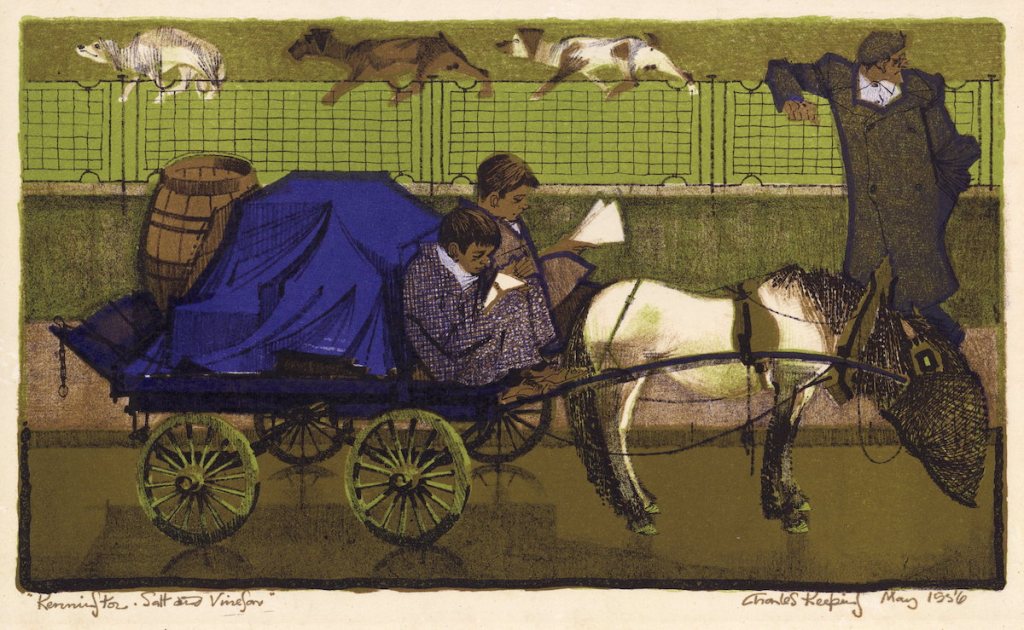
Writing for Printmaking Today in 2003, I shared my experiences of collecting prints and drawings on eBay, the world’s most popular online car boot sale. Twenty years on, I am still from time to time foraging the pages of eBay looking for the bargain of a lifetime. For this post, I will be revisiting and revising my 2003 essay, and reflecting on a quarter century of accumulating this, that, and nothing in particular.
I have been bidding for art on eBay pretty much since its inception. In those early days, the pickings were rich. Vendors did not always know the significance of their listings, and collectors were still wary of being duped. As well as a source of art, eBay has helped refurbish, decorate and furnish our large Victorian semi (from a new-in-its-box Villeroy & Boch whirlpool bathtub to antique rugs, Knole sofas, and 1930s Brynmawr oak furniture). It has enriched our library, stocked our garden, and helped grow my husband’s burgeoning Claudette Colbert memorabilia collection.
eBay is a remarkably simple concept. It allows anyone in the world with internet access to ‘Buy It Now’ shop or buy/sell goods via person-to-person online auction. It is a friendly marketplace where traders and collectors can meet others with similar interests and enthusiasms. While millions of private individuals trade from time to time, there are others who have made a profession of eBay commerce. For them, eBay‘s commission is considerably less than the overheads of a high-street store, and their customer base is potentially global.
eBay was launched in September 1995 by Pierre Omidyar. Born in Paris and raised in Maryland, Omidyar graduated in computer science at Tufts University, Massachusetts in 1988. A software developer for Apple, then engineer at a mobile-communications company, he originally developed eBay on his personal web pages as a platform for his girlfriend to collect and trade candy dispensers. When offered more widely, initially as a free service, major investors quickly realised its potential. In 1998, eBay was floated as a public company and its share prices soared. Today, eBay operates in 32+ countries, from Argentina to Australia and Canada to Korea.
Browsing and Searching for Prints
An eBay search for “prints” pulls together a wide range of national and international vendors. Among them are private collectors thinning their collection or trading up, entrepreneurial young artists plying their creative outputs, established dealers breaking into a new market, and traders in general antiques and collectibles. English-language searches primarily uncover items in the UK and US as well as occasionally in Australia, Canada and some European countries. On occasion, I might take a punt on “radierung” in Germany, “cadre Montparnasse” in France, or “litografia” in Italy (though Brexit scuppered this potentially low-cost line of inquiry). At first, I used www.ebay.com rather than www.ebay.co.uk. As a collector of twentieth-century British prints, I initially found excellent representations among North American vendors. Shipping was at first inexpensive and, back in 2003, the GB pound was strong against the US dollar.
The works of most printmakers from the Renaissance to contemporary can be found on eBay. The Continentals, for example, are in abundance with signed limited edition prints by Braque, Chagall, Dali, Dufy, Matisse, Miro and Picasso, but these come at a price and are not always what they purport to be.
eBay is most thrilling when there is the prospect of a bargain. However, I make sure that I know what I am bidding for and its market value. I establish a ceiling on what I am prepared to bid. Before getting carried away with bidding, I check prices against those offered via reputable dealer websites or salesroom results.
Browsing on eBay becomes too unwieldy when following on-screen links from ‘Art’ to ‘Art Prints’ to ‘Antique (pre-1900)’, ‘Modern (1900-49)’ and ‘Contemporary (1950-now)’. Since the terms ‘print’, ‘original’ and ‘limited edition’ are used indiscriminately, even by those who should know better, such keyword searches are of little use. A 2023 search for ‘Print’ within ‘Art’, for example, turned up 2.3M+ items. These ranged from Moulin Rouge poster reprints and canvas-effect reproductions of Bouguereau’s Madonna of the Roses to GAP boxer shorts and a leopard print diaper bag.
A search for ‘Original Print’ narrowed the field to 190K hits, though few of these I would regard to be an original print. My first ‘Original Print’ search turned up a Victorian cabinet photograph of a cowboy in wool chaps seated on a cow, a ubiquitous Thomas Kinkade sunrise, ‘a 1967 slide of a busty woman on the rocks’ and a 16mm feature, Mr Magoo in Sherwood Forest. A search for ‘Limited Edition Original Print’ resulted in 160K hits. Even so, most were reproductions or photographs.
When not searching a specific artist’s name, I use non-exact phrase keywords such as ‘Pencil Signed British Engraving’, ‘Pencil Signed British Woodcut’. I narrow the search further by looking for organisations with whom my sought-after artists might have been associated: ‘Works Progress Administration’, ‘Slade School’, or ‘Royal Academy of Art’, remembering to use double quotation marks to search exact phrase only. Checking the box ‘Include Description’ extends the search.
If a search turns up items of interest to me, I generally check out ‘See Other Items’ from the vendor and maybe ‘Save Seller’ for future browsing. The ‘Save This Search’ option allows me to bookmark favourite searches and receive an email to alert me when new items are listed.
Assessing Your Search Results, Watching and Bidding
Inevitably prints will be offered by some who not best equipped to describe them, recognise an original print, identify the medium, or indeed point out that it is hand signed. This can work to the advantage of the buyer. Check out any condition report, examine closely the photographs, and read descriptions carefully. If in doubt, ‘Contact Seller’ with a question.
In the early years of eBay, the pricing structure to list an item encouraged vendors to start low, as low as 99 cents / 99 pence, and to sell without a reserve. The expectation was that the item would reach or even exceed its rightful worth in a bidding war. But unless someone else also alighted on the item, and wanted it enough to enter the auction, artworks could be acquired with a derisory virgin bid.
Even though items are listed for one, three, five, seven or ten days, and buyers can leave a bid 24/7 during that period, experienced eBayers tend to bid just minutes before the auction closes. I quickly learned never to show early interest by placing a premature bid on an item. It is all too easy to become embroiled in a bidding war and see the price escalate. Before bidding, it’s important to note the ‘Item Location’ and read the vendor’s preferred methods of ‘Shipping and Payment’ to ensure you can comply with the terms. A bank card or PayPal are safest and most common.
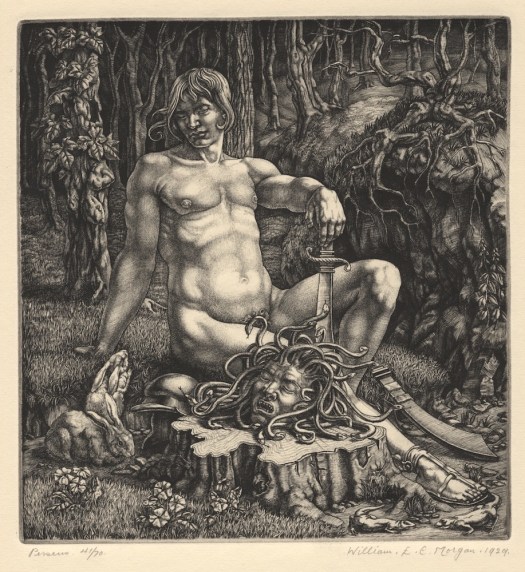
I keep my powder dry to enter the race in the final ten seconds of the listing. Five seconds, if I can keep my nerve. I place my ceiling bid in the closing seconds, ensuring that my competitor[s] does not have time to place a counter bid. I am generally successful if my internet connectivity is match fit and my opponent is not subscribing to an automated service such as http://www.auctionsniper.com. One stormy night, when my internet was dropping, I drove to my work office at 2AM to bid on four pristine, never-before framed line engravings by William Evan Charles Morgan, listed by a vendor on the East Coast USA (hence the late hour in the UK). My tenacity paid off. I netted all four prints for $50 each.
In order to bid last minute, I have on occasion found myself bidding from a mobile phone in a restaurant or seated on the floor of a shopping mall in Prague, piggy backing on the wifi of fast food outlet. The latter netted me a collection of 1950s etchings and lithographs by Alistair Grant (1925-1997). But if I cannot be online when an auction closes, I enter my maximum bid and allow eBay will bid incrementally on my behalf. ‘Buy it Now’ and ‘Make an Offer’ are useful options for immediate purchase, assuming that I am satisfied with the asking price and I do not wish to risk losing the item, as I have done by hesitating. Happily, I have a healthy attitude toward eBay auctions: if I miss out on an artwork that could have been mine for £100, I look on it as £100 extra in my pocket that would not be there tomorrow.
Feedback and Safeguards
Spare a little time to read vendors’ ‘Feedback’. This is the rating system for buyers and sellers to comment upon their experience of trading with other users, the merchandise, quality of service and reliability. The ‘Feedback’ number and a colour-coded star-rated link are in parenthesis after the user ID.
eBay is self-policed by the users, these accumulated comments remain as a permanent feature of a member’s profile; an incentive for eBayers to get it right, it engenders trust and allows the user to build a reputation.
From the outset eBay has relied upon trust. ‘Most people are honest,’ Omidyar assures us, ‘and they mean well. Some people go out of their way to make things right. But some people are dishonest, or deceptive … But here, those people can’t hide. We’ll drive them away and protect others from them. By creating an open market that encourages honest dealings, I hope to make it easier to conduct business with strangers over the net.’
 Robert Meyrick