
knceqknv’k envenom town vpqw pownvpqnw qpowv ownvq qnqnv inpqenvq qenvoqugo c
Robert Ashwin Maynard and the Genesis of Gregynog Press

In preparation …
New insights into the origins of the Gregynog Press. Come back soon.

Valerius de Saedeleer

AT THE HEIGHT OF A GLOBAL ECONOMIC RECESSION, acclaimed Belgian landscape painter Valerius de Saedeleer began to explore the commercial potential of limited-edition reproductive prints both as a means of income generation and to create a greater awareness of his artworks through their wider distribution. Between 1930 and 1938 Saedeleer collaborated with highly-skilled printmakers Jan de Cooman (1893-1949), Armand Apol (1879-1950), Frans Ermengem (1893-1985) and Roger Hebbelinck (1912-1987) to produce intaglio transcriptions in colour after some of his most popular canvases.
Boyens, Piet. Valerius de Saedeleer: De tuin der afwezigen (The Garden of the Absent). Lannoo, 2006.
Milo, Jean. Valerius de Saedeleer. Dietrich & Co., Brussels, 1934.
Ridder, André de. Valerius de Saedeleer en Zuid-Vlaanderen. Bij de Boekengilder ‘Die Poorte’, Antwerp, 1938.
Walravens, Jan. Valerius de Saedeleer. Ministry of Public Education, Antwerp. Undated.
To be continued …
ROGER HEBBELINCK

1
Roger Hebbelinck (1912-1987) after Valerius de Saedeleer
Bomen bij de Hoeve (Trees by a Farm)
Etching and aquatint in colours on heavy white wove, 19xx
630 x 490 mm (24¾ x 19¼ in.)
Edition 125 + artist proofs
Ins: [plate, lower left] Valerius de Saedeleer [lower margin left, pencil] 112/125 [right] R. Hebbelinck
After a c.1927 oil painting of the same title (Boyens, p.140). Zonsondergang.

Roger Hebbelinck (1912-1987) after Valerius de Saedeleer
Het kleine Dorp in de Sneeuw (Small Village in the Snow) Smaller version
Etching and aquatint in colours on heavy white wove, 19xx
495 x 550 mm (19½ x 21¾ in.)
Edition 125 + artist proofs
Ins: [plate, lower left, signature] Valerius de Saedeleer [lower margin left, pencil] 54/125 [right, signature] R. Hebbelinck
After a 1933 oil painting of the same title (Milo, unnumbered).

Roger Hebbelinck (1912-1987) after Valerius de Saedeleer
Het kleine Dorp in de Sneeuw (Small Village in the Snow) Larger version
Etching and aquatint in colours on heavy white wove, 19xx
548 x 595 mm (21½ x 23½ in.)
Edition 250 + artist proofs
Ins: [plate, upper left] Copyright Dietrich & Co., Brussels. Gravé et imprimé par R. Hebbelinck (not all impressions thus) [lower right, signature stamp] Valerius de Saedeleer [lower margin left, pencil] R. Hebbelinck [right] épreuve d’artiste [oval blind stamp] Dietrich & Co.
After a 1933 oil painting of the same title (Milo, unnumbered).
4
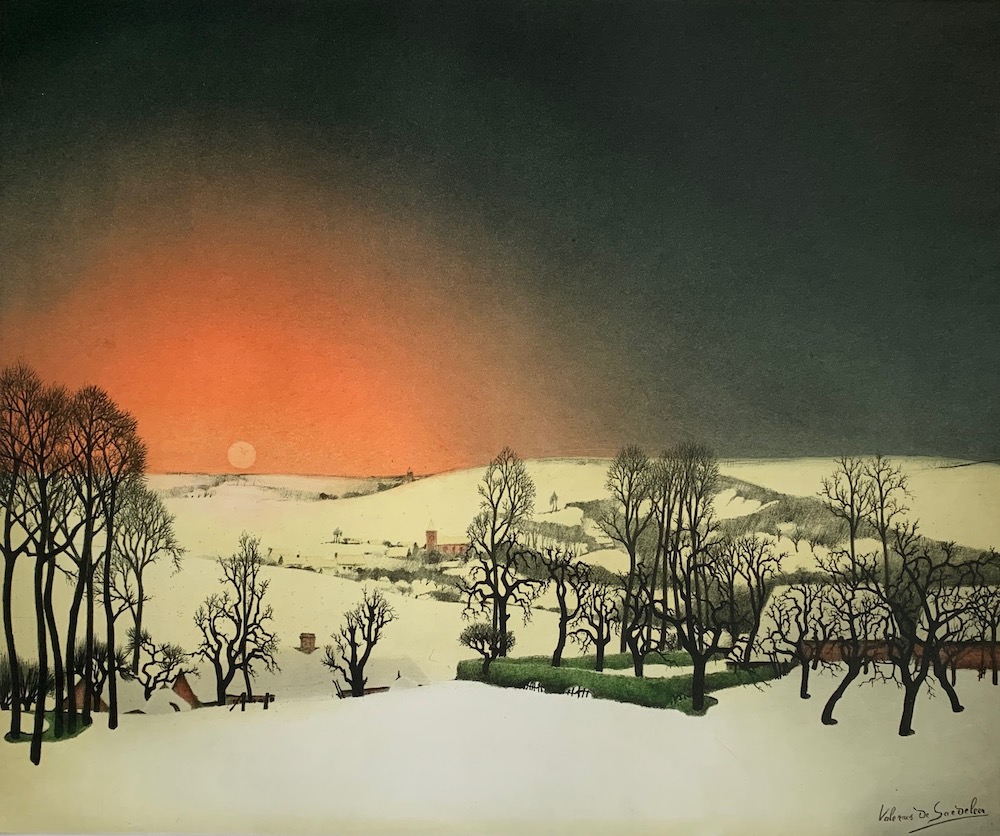
Roger Hebbelinck (1912-1987) after Valerius de Saedeleer
Het Dorp in de Sneeuw (Village under Snow) I
Etching and aquatint in colours on heavy white wove, 19xx
493 x 593 mm (19½ x 23½ in.)
Edition 125 + artist proofs
Ins: [plate, lower right] Valerius de Saedeleer [lower margin left, pencil] R. Hebbelinck [right] 89/125
After a 1928 oil painting of the same title in the collection of the Musée Royal des Beaux-Arts, Anvers (Milo, unnumbered; Walravens, pl. 17; Ridder pl. XI).

5
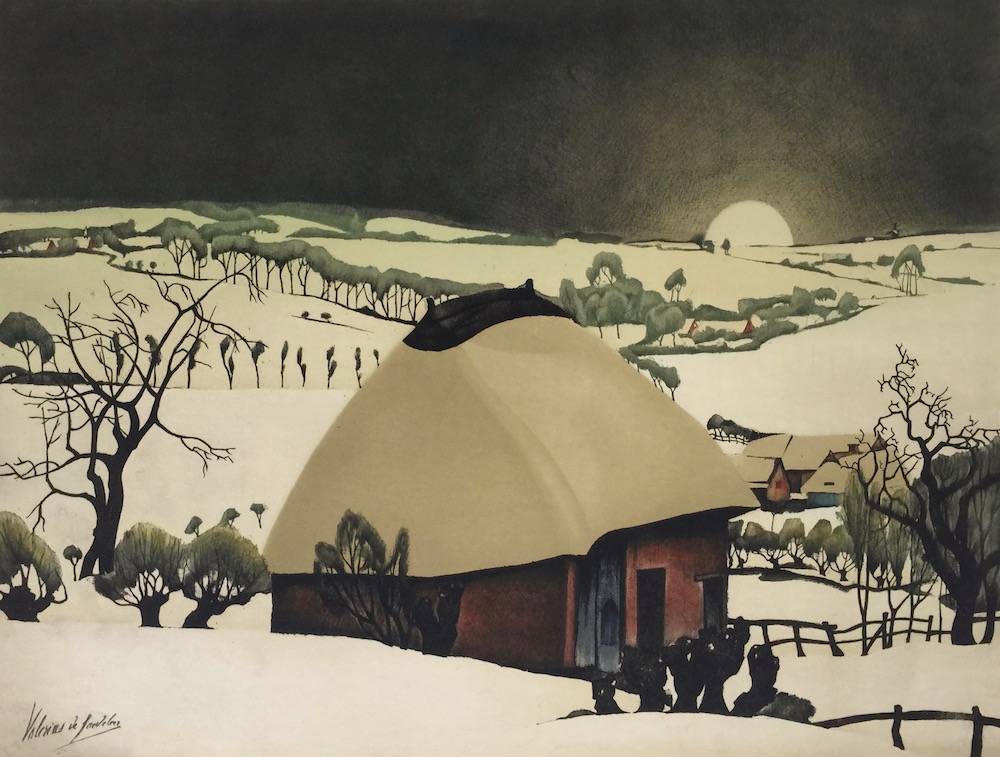
Roger Hebbelinck (1912-1987) after Valerius de Saedeleer
Het Dorp in de Sneeuw (Village under Snow) II
Etching and aquatint in colours on heavy white wove, 19xx
xxx x xxx mm (xxx x xxx in.)
Edition 250 + artist proofs
Ins: [plate, lower right, stamp] Valerius de Saedeleer [lower margin left, pencil signature] R. Hebbelinck [right] 145/250
After a 1928 oil painting of the same title in the collection of the Musée Royal des Beaux-Arts, Anvers (Milo, unnumbered; Walravens, pl. 17; Ridder pl. XI). This is a second larger version of above printed in greens and published by Dietrich of Brussels.
6
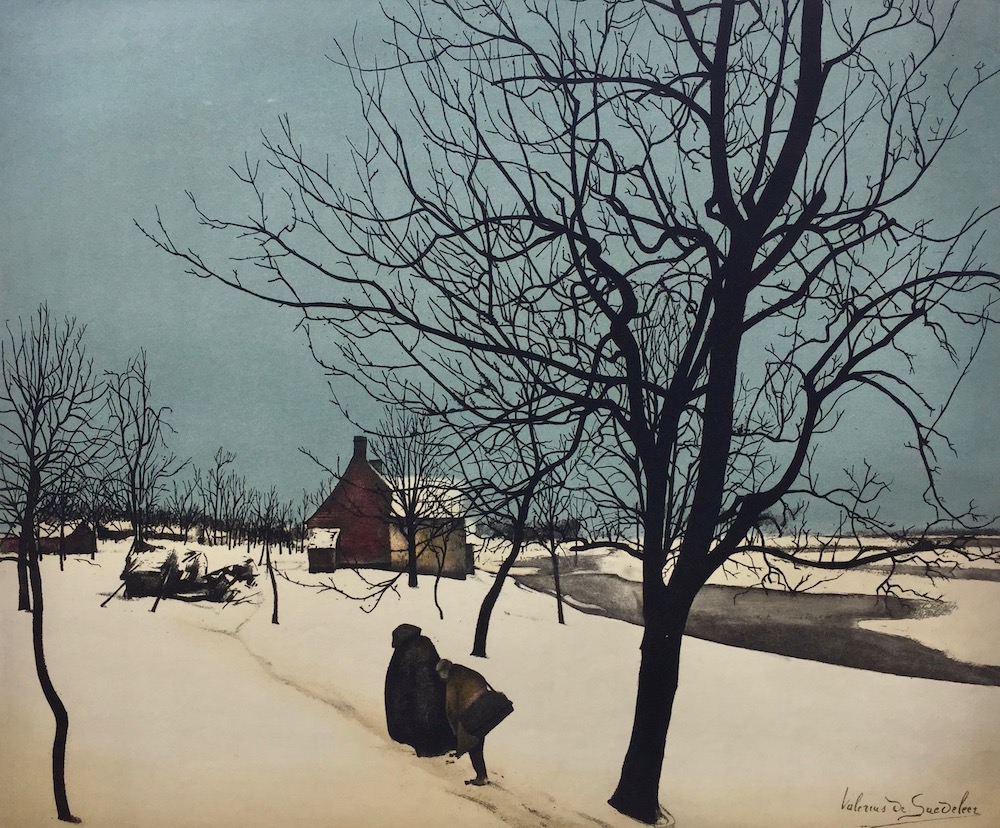
Roger Hebbelinck (1912-1987) after Valerius de Saedeleer
Winter in Etikhove (Winter in Etikhove)
Etching and aquatint in colours on heavy white wove, 19xx
493 x 646 mm (19½ x 25½ in.)
Editions of 125 and 350 + artist proofs
Ins: [plate, lower right] Valerius de Saedeleer [lower margin left, pencil] 52/350 [right] R. Hebbelinck
After a ca.1926 oil painting of the same title in the collection of the Stedelijk Museum, Aalst (Boyens, p. 133).
7
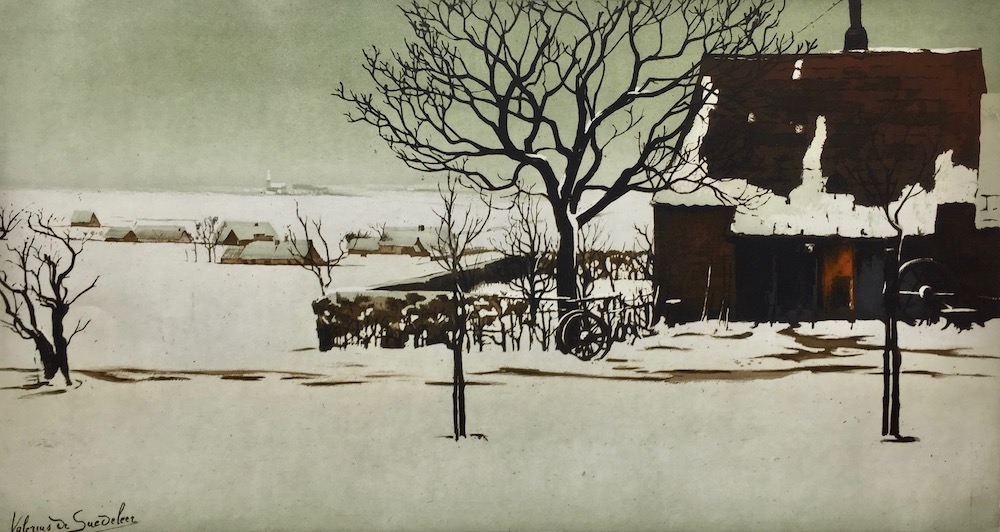
Roger Hebbelinck (1912-1987) after Valerius de Saedeleer
Winterlandschap met Hoeve (Snow Scene with Farmhouse)
Etching and aquatint in colours on heavy white wove, 19xx
495 x 590 mm (19½ x 23¼ in.)
Edition 125 + artist proofs
Ins: [plate, lower right signature] Valerius de Saedeleer [lower margin left, pencil signature] R. Hebbelinck [right, pencil] 39/125
After a 1907 oil painting of the same title (Milo, unnumbered; Walravens, pl. 10; Boyens, p. 144; Ridder pl. VII).
8
Roger Hebbelinck (1912-1987) after Valerius de Saedeleer
De Smederij onder de Sneeuw (The Forge under Snow)
Etching and aquatint in colours on heavy white wove, 19xx
355 x 646 mm (14 x 25½ in.)
Edition 125 + artist proofs
Ins: [plate, lower left signature] Valerius de Saedeleer [lower margin left, pencil signature] 33/125 [right, pencil signature] R.Hebbelinck [edge of sheet, pencil] La Forge sous la Neige
After an unrecorded oil painting.

9
Roger Hebbelinck (1912-1987) after Valerius de Saedeleer
Winter in Vlaanderen (Winter in Flanders)
Etching and aquatint in colours on heavy wove paper, 19xx
494 x 497 mm (19½ x 19½ in.)
Edition 125 + artist proofs
Ins: [plate, lower right, signature] Valerius de Saedeleer [lower margin left, pencil] 24/125 [lower margin, right signature] R. Hebbelinck
After a 1923 oil painting of the same title (Milo, unnumbered; Ridder pl. VIII).
10
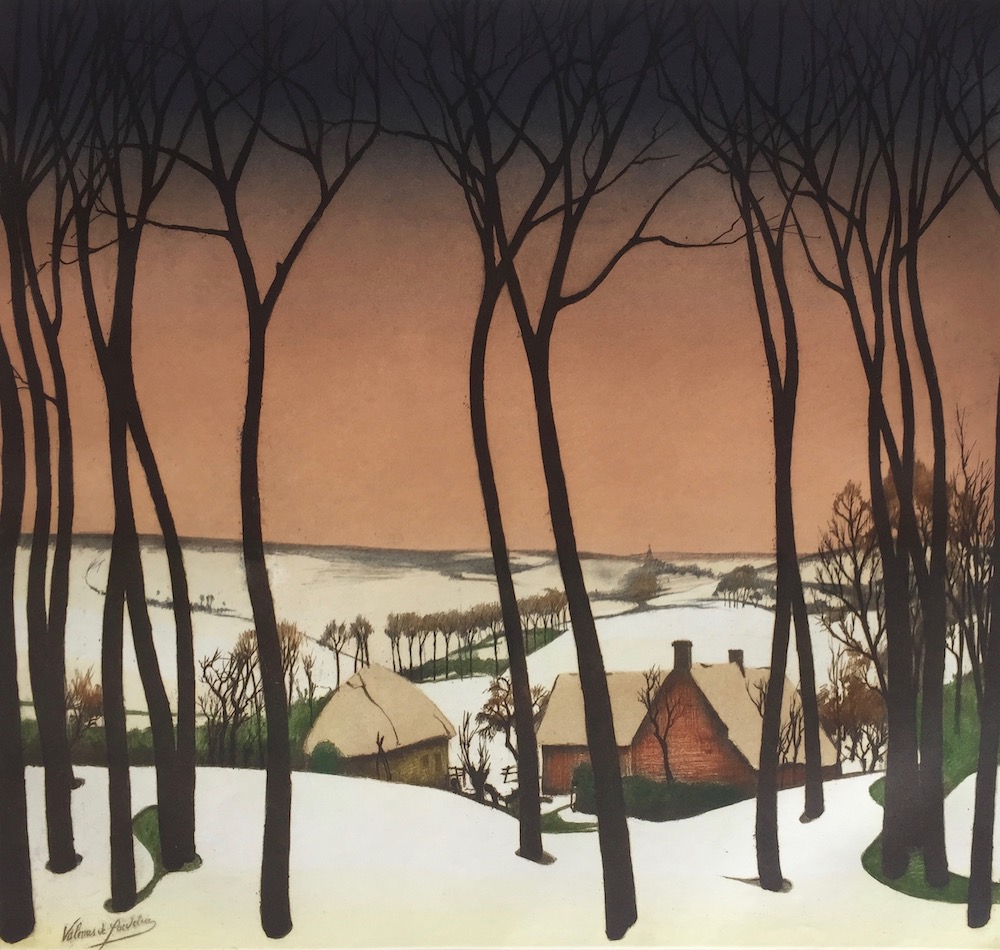
Roger Hebbelinck (1912-1987) after Valerius de Saedeleer
Les Grands Arbres (The Tall Trees)
Etching and aquatint in colours on heavy white wove, 19xx
495 x 524 mm (19½ x 20½ in.)
Edition 125 + artist proofs
Ins: [plate, lower left] Valerius de Saedeleer [lower margin left, pencil] 18/125 [right, pencil signature] R. Hebbelinck
After a ca.1927 oil painting Winter in Vlaandderen | Volle Winter in the collection of the Musée Royal des Beaux-Arts, Anvers (Walravens, frontispiece; Boyens, p.136).
ARMAND APOL

11
Armand Apol (1879-1950) after Valerius de Saedeleer
Les Grands Arbres (The Tall Trees)
Etching and aquatint in colours on heavy wove paper, 1930
552 x 575 mm (21¾ x 22¾ in.)
Edition 250 + artist proofs
Ins: [plate, lower left, signature] Valerius de Saedleer [lower right, lettered] Grave par Apol 1930 [lower margin left, pencil] B 201/250 [lower margin centre, pencil] Les Grands Arbres [lower margin left, pencil] Armand Apol
After a ca.1927 oil painting Winter in Vlaandderen | Volle Winter in the collection of the Musée Royal des Beaux-Arts, Anvers (Walravens, frontispiece; Boyens, p.136).

12
Armand Apol (1879-1950) after Valerius de Saedeleer
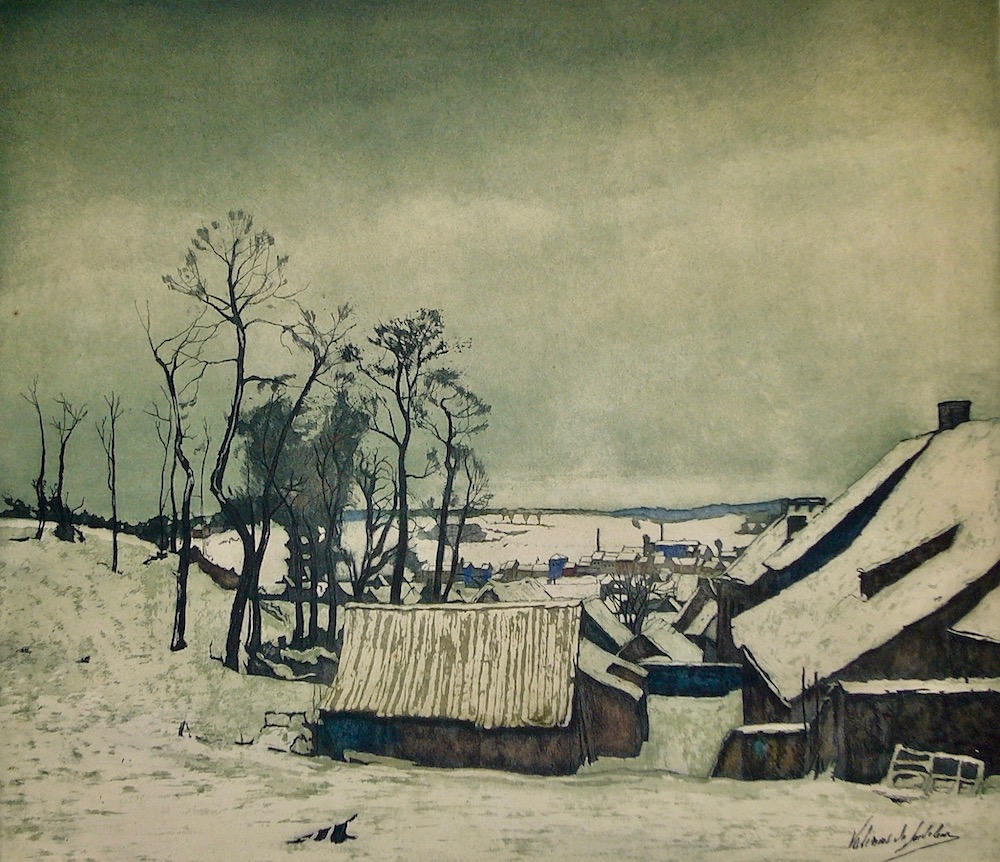
De Oude Boomgaard in den Winter (An Old Orchard in Winter)
Etching and aquatint in colours on heavy wove paper, 19xx
515 x 585 mm (20¼ x 23 in.)
Edition 250 + artist proofs
Ins: [plate, lower right, signature] Valerius de Saedeleer [lower margin left, pencil] B57/250 [lower margin centre, pencil] Verger sous la Neige [lower margin right, pencil] Gravé par Armand Apol
After a 1925 oil painting of the same title (Milo, unnumbered; Walravens, pl. 11; Boyens, p. 121).
13
Armand Apol (1879-1950) after Valerius de Saedeleer
xxx (xxx)
Etching and aquatint in colours, 19xx
488 x 565 mm. (19¼ x 22¼ in.)
Edition 200 (also seen 300) + artist proofs
Ins: [plate, lower right, signature] Valerius de Saedeleer [lower margin left, pencil] épreuve d’artiste [lower margin right, pencil] Armand Apol sc.

14
Armand Apol (1879-1950) after Valerius de Saedeleer
Herfst (Autumn)
Etching and aquatint in colours in heavy white wove, 1939
498 x 565 mm (19½ x 22¼ in.)
Edition 200 + artist proofs
Ins: [plate, lower left] Valerius de Saedeleer 38 [lower right] Gravé par Apol 1942? [lower margin right, pencil] Certifié Authentique J. de Saedeleer [lower margin, stamp] xxx
After a 1938 oil painting of the same title (Boyens, p. 164).

15
Armand Apol (1879-1950) after Valerius de Saedeleer
Het Bosch in den Winter (The Wood in Winter)
Etching and aquatint in colours in heavy white wove, 19xx
525 x 576 mm (20¾ x 22¾ in.)
Edition ???
Ins: [plate, lower left] Gravé par Apol [lower right] Valerius de Saedeleer [lower margin right, pencil] épreuve derrier étut / Bois sous la neige [left] Armand Apol
After a ca.1924 oil painting of the same title (Milo, unnumbered; Boyens, p. 144).
JAN DE COOMAN
16
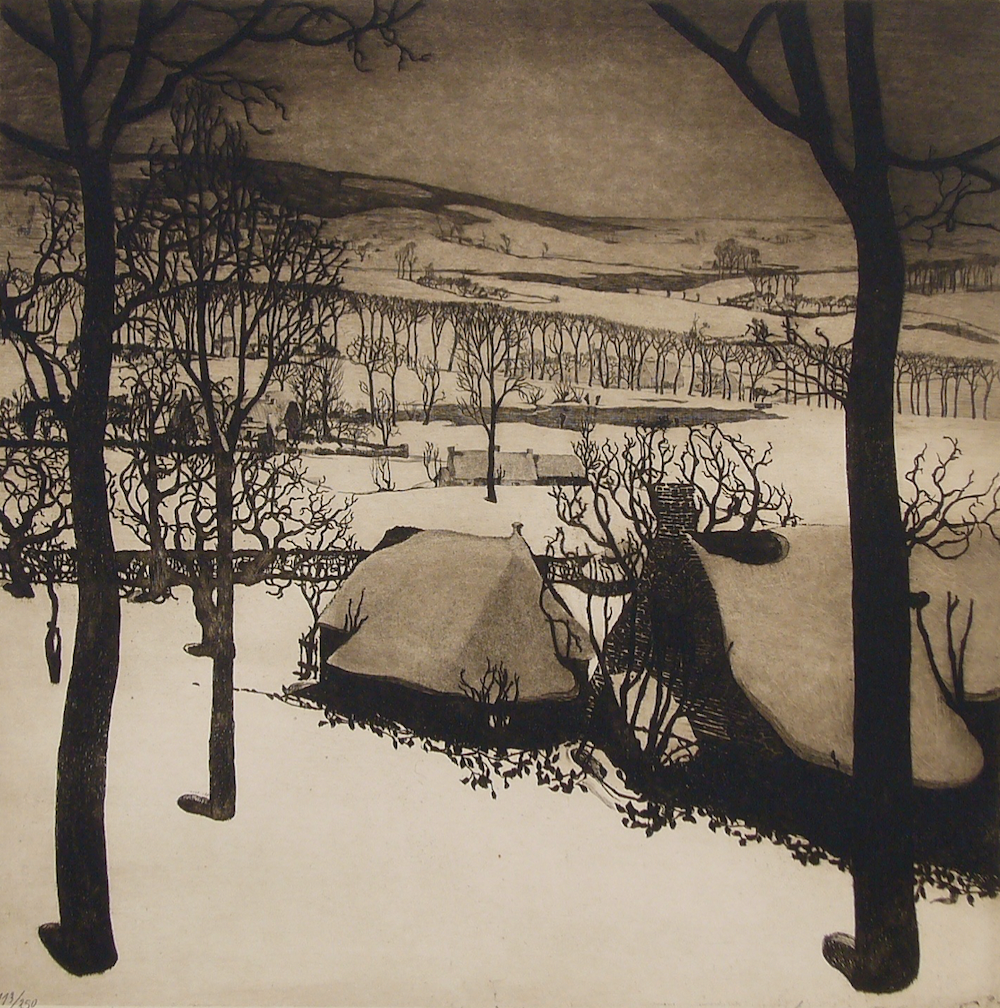
Jan de Cooman (1893-1949) after Valerius de Saedeleer
Winter in Vlaanderen (Winter in Flanders)
Etching and aquatint in black on heavy wove paper, 1934(?)
394 x 400 mm (15½ x 15¾ in.)
Edition 250 + artist proofs
Ins: [lower margin left, pencil signature] J de Cooman sc. 113/250 [lower margin right, pencil signature] Valerius de Saedeleer
After a 1923 oil painting of the same title (Milo, unnumbered; Ridder pl. VIII).
17
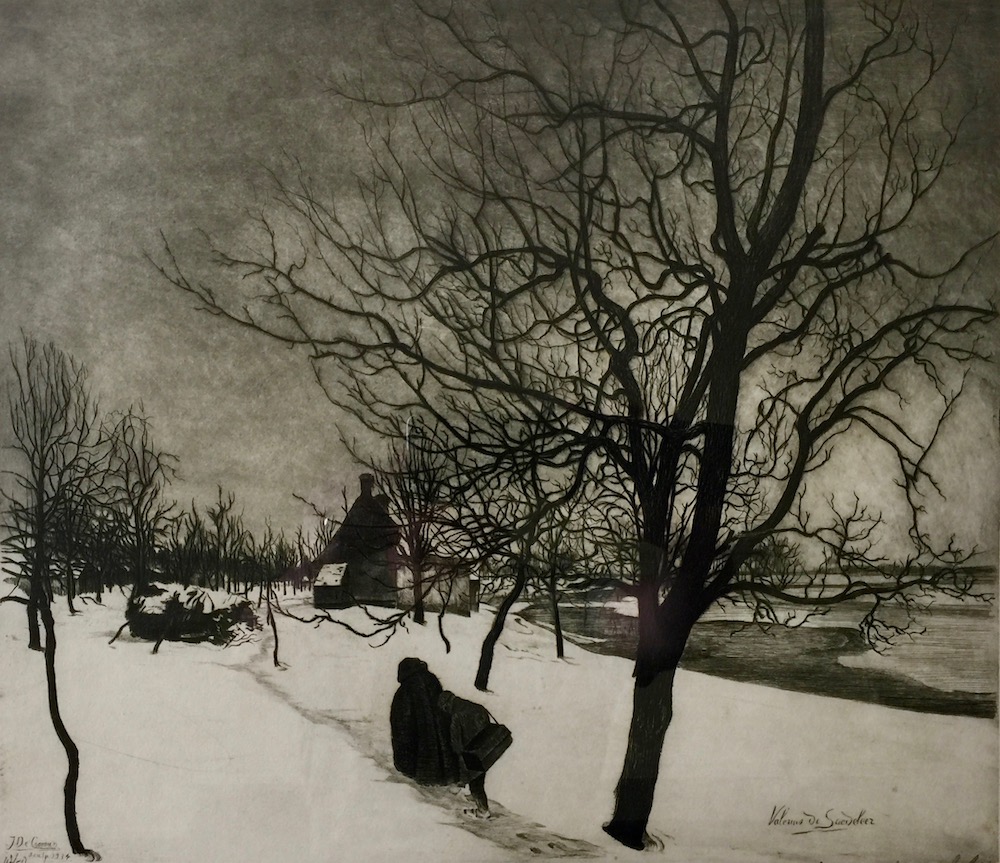
Jan de Cooman (1893-1949) after Valerius de Saedeleer
Winterlandschap met Hoeve (Snow Scene with Farmhouse)
Etching in black on heavy wove paper, 1934
395 x 457 mm (15½ x 18 in.)
Edition 50
Ins: [plate, lower left] J de Cooman sculp. 1934 [lower right, signature] Valerius de Saedeleer [lower margin left, pencil signature] J de Cooman 42/50 [lower margin centre, oval blind stamp] J de Cooman [lower margin right, pencil signature] Valerius de Saedeleer
After a 1907 oil painting of the same title (Milo, unnumbered; Walravens, pl. 10; Boyens, p. 144; Ridder pl. VII).

Jan de Cooman (1893-1949) after Valerius de Saedeleer
[Orchard at the End of Winter]
Etching and aquatint in colours on wove paper, 193x
xxx x xxx mm (xx x xx in.)
Edition 250
Ins: [pencil, lower margin left] 34/250 Jan de Cooman [pencil, lower margin right] Valerius de Saedeleer [plate lower right] Valerius de Saedeleer
After an oil painting. Not reproduced in Milo, Walravens, Boyens or Ridder.
————————————————————————————————————
Jan de Cooman (1893-1949) after Valerius de Saedeleer
Winter in Vlaanderen (Winter in Flanders)
Etching in black on heavy wove paper, 19xx
164 x 159 mm (6½ x 6¼ in.)
Edition ???
Ins: [plate, lower right, signature] Valerius de Saedeleer pinx. [lower margin right, pencil signature] J de Cooman [centre margin, oval blind stamp] J de Cooman
Collection: Aberystwyth University
After a 1923 oil painting of the same title (Milo, unnumbered).
§
Armand Apol (1879-1950) after Valerius de Saedeleer
xxxx (Orchard at the End of Winter)
Etching and aquatint in colours on heavy wove paper, 1930
552 x 575 mm (21¾ x 22¾ in.) guesstimate
Edition ???
Ins: [plate, lower left, signature] xxx [lower right, lettered] xxx [lower margin left, pencil] xxx [lower margin centre, pencil] xxx [lower margin left, pencil] xxx
After …
§
[Windmill]
une eau-forte de Valerius de Saedeleer Dim: 34 x 47 cm E
§
Jan de Cooman (1893-1949) after Valerius de Saedeleer
xxxx (xxxx)
Etching and aquatint in colours on heavy wove paper, 19xx
440 x 360 mm (17¼ x 14¼ in.)
Edition ???
Ins: [plate, lower right, signature] xxx [lower margin right, pencil signature] xx/xxx J de Cooman [lower margin, stamp] Valerius de Saedeleer [pencil] xxx
After …
§
Jan de Cooman (1893-1949) after Valerius de Saedeleer
Appelboom in de Sneeuw (Apple Tree in the Snow)
Etching and aquatint in black on heavy wove paper, 19xx
xxx x xxx mm (xxx x xxx in.)
Edition 250
Ins: [plate, lower left, signature] xx/250, J de Cooman [plate, lower right, stamp] Valerius de Saedeleer [lower margin right, pencil signature] xxxx xxxx J de Cooman
After …
Vingt Poèmes by Émile Verhaeren
20 etchings with aquatint by Roger Hebbelinck after landscape paintings by Saedeleer to decorate the special volume of Vingt Poèmes by Émile Verhaeren (Brussels: Terres Latines, 1947). Edition 200 + small number of hors commerce.
§
Roger Hebbelink (1912-1987) after Valerius de Saedeleer
Winter in Vlaanderen (Winter in Flanders)
Etching and aquatint in black on Arches heavy wove paper, 1947
xxx x xxx mm (xx x xx in.)
Edition 200 + small number of hors commerce
Ins: None
After a 1923 oil painting of the same title (Milo, unnumbered).
David Tinker
Under construction …


Gwilym Prichard
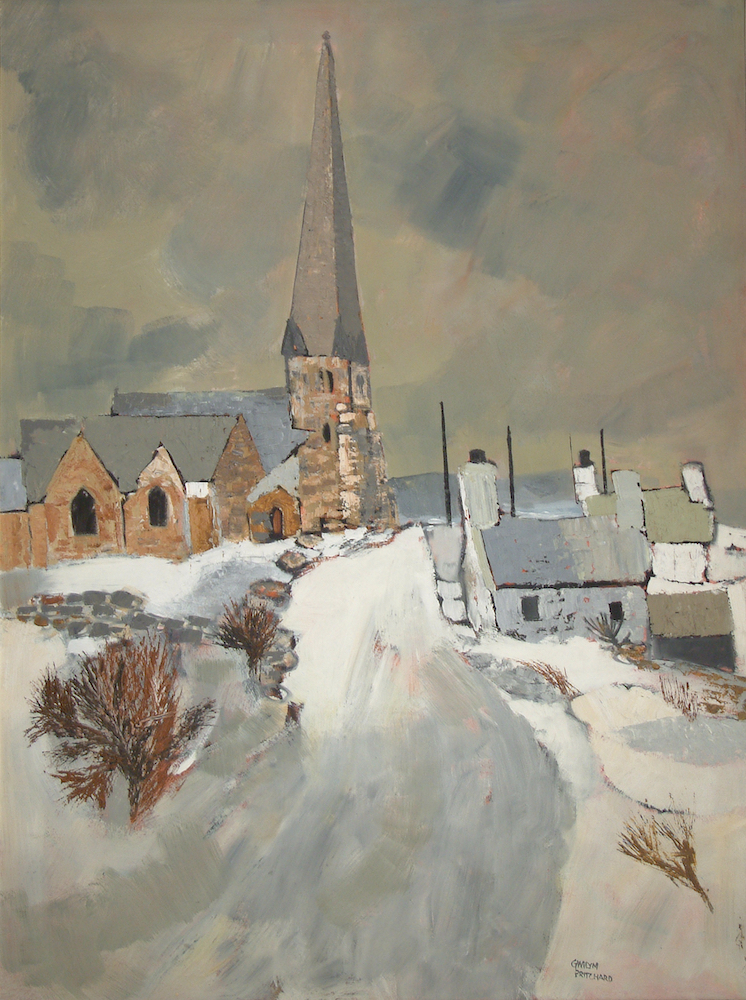
THOUGH GWILYM PRICHARD painted in Brittany, Provence, Italy, Greece and Tunisia, he is best remembered for his landscapes of Anglesey, Cader Idris, Tan-y-Grisiau and the upland and coastal regions of north Wales – a stark and weather-beaten terrain. He might fairly be described as an artist of regional expression, one who communicated his love of a locality. Like John Elwyn in Cardiganshire, George Chapman in the Rhondda Valley, Samuel Palmer in Shoreham and John Constable in Suffolk, Prichard returned to well-known subjects and sought new solutions to familiar problems. The play of light on a hillside, a snow encrusted farm in winter, a meandering sheep track, or an approaching storm are recurrent motifs in his work. He observed and interpreted his native landscape with what artist Sir Kyffin Williams once described as Celtic exuberance. As Prichard himself pointed out in a 1974 catalogue of his artworks at Heal’s Mansard Gallery, London:
As an emotional Celt I tend to paint from the heart. I enjoy the act of working the paint. My concern is to convey my emotions and enthusiasm for Wales through richness of texture, paint and colour. I see my work through music, song and poetry.
Prichard had embarked on a career as a professional artist at a time when several initiatives had been set in motion to nurture and promote the visual arts in Wales. He was one of the generation of painters that emerged from post-war austerity to benefit from opportunities that existed to participate in exhibitions of contemporary Welsh art mounted by institutions such as the Arts Council of Wales, the Society for Education through Art, the National Eisteddfod and the National Museum of Wales. It was hoped that these initiatives would help improve the cultural climate for artists, expand the practice of art in Wales, and put Welsh art before a wider audience.

Gwilym Arifor Pritchard was born March 4, 1931, the second son of Rhoda and Hugh Ivor Pritchard of Llanystumdwy near Criccieth, Caernarfonshire. Gwilym dropped the ‘t’ in his spelling of Prichard in 1980 after he saw an exhibition catalogue with works by ‘another’ Gwilym Pritchard. A diocesan lay reader and church organist, Hugh Pritchard had served in World War I, graduated from The University College of Wales, Aberystwyth, and was headmaster of Llanystumdwy village school for 28 years. Gwilym’s early experiences in the foothills of the Eryri Mountains shaped his attitude toward landscape and his art. In his 1974 Heal’s catalogue he recalled a happy childhood ‘by the river Dwyfor’ where he spent most of his ‘time fishing on the ever-changing flowing river. For me,’ he continued, ‘nature and landscape were part of my life; the river my bloodstream.’
Gwilym’s older brother Arthur Pritchard (1927–1993) began his career as an articled pupil in the County Surveyor’s Office in Caernarfon, qualified as a chartered surveyor and became area engineer for Gwynedd County Council’s Highways Department at Llangefni. He took up painting in the mid-1950s and exhibited with success throughout Wales and in London.
Gwilym Prichard attended Portmadoc Grammar School where it was the chemistry teacher who kindled his interest in art. ‘There was some hope for those who had a tidy mind,’ he wrote for Hywel Harries’s 1983 anthology Cymru’r Cynfas, ‘and who could manage accurate and well-polished outlines, but I had no such talent.’ In 1948 Pritchard was posted to Yatesbury in Wiltshire where he began National Service training as a radar engineer. He contracted rheumatic fever and spent much of 1949 in hospital in Swindon. In 1950 he enrolled on a two-year art teacher training course at Normal College, Bangor followed by a diploma course at Birmingham College of Art in 1953 where he mostly practised ceramics and weaving.
In 1954 Prichard married Claudia Williams who had moved to Wales with her parents in 1946 when her father, a London-born civil servant, retired to Llangybi near Chwiliog on the Lleyn Peninsula. Claudia was born in Purley, Surrey in 1933 and trained at Chelsea School of Art 1950 to 1953. Their first home was on Anglesey, where they lived above a newsagent’s shop until the birth of their son Ceri when they moved into a council house at Pencraig, Llangefni.

Gwilym Prichard had never set out to become a painter. He claimed that he had only taken an interest in art to win the attention and affections of Claudia Williams. ‘Love and Art hit me at about the same time,’ Prichard recalled of the defining moment in his life when ‘this girl on a grey horse’ came riding ‘down the road to the junction where [he] was daydreaming.’ She stopped, looked down at him and he looked up at her.
As artists, their domestic circumstances attracted considerable press attention with newspaper headlines that ran ‘After the Children are put to Bed’ and ‘Happy Ending to Six Months’ Hard Labour.’ Importantly they were seen as painters who practised on an equal footing. Williams’ career developed alongside that of her husband even though it was not possible for her to concentrate on painting for sustained periods of time when the children – eventually four of them – were very young. She relied on sketchbook studies of her young family and friends for her paintings. Consequently, motherhood and family life have been a recurrent theme in her work as she observed women and children going about their daily routine, in conversation at the dinner table, at play, or bathing. From her earliest family holidays the beach provided a rich subject: women and children sunbathing, swimming, changing swimsuits and preparing a picnic. Mothers relax in the sun and the children are absorbed in their play by a rock pool, collecting shells, building sandcastles and flying kites.
From as early as 1952, Prichard was a regular contributor to Portmadoc Group exhibitions. He went on to participate in exhibitions throughout Wales: at the National Eisteddfod, Royal Cambrian Academy, Arts Council of Wales, Society for Education through Art, and ‘Contemporary Welsh Painting’ at the National Museum of Wales as well as Howard Roberts Gallery in Cardiff.
In 1954 Prichard was appointed crafts teacher at Llangefni County Secondary School where for eleven years he taught weaving, pottery and other crafts. His weekday teaching post required that he took every opportunity to paint outdoors at weekends. Family camping holidays in the remote corners of Anglesey also gave him the opportunity to make drawings that were later worked up into paintings. With young children, setting out on careers as professional artists required enormous commitment and determination to succeed. For Claudia to paint and continue to exhibit they took turns in the studio in the front room of their home. Gwilym shared with his wife the housework, cooking and looking after the children. In August 1958 the family moved to Old Bank House in Church Street, Beaumaris.

For Prichard south-east Anglesey, within the triangle formed by Pentraeth, Penmon and Beaumaris, became a favourite haunt. He painted in and around the ancient Penmon Priory, Puffin Island, Black Point, Penmon Lighthouse and Red Wharf Bay. It is a geographically interesting landscape, the soil eroded by westerly gales exposing the hard Penmon limestone beneath. As Prichard observed in a 1963 catalogue entry for his exhibition at Howard Roberts Gallery, Cardiff:
My paintings fall roughly into four groups: Penmon Priory, houses in snow, still lives and farms in landscape. These groups are linked in some way with the four seasons. The May trees in spring turn Anglesey into a mass of white primitive shapes and subtle tones. Summer of ripe corn – Môn Mam Cymru. Autumn and early winter is a productive period in my painting. This is the time of clear light, even on dull cloudy days. The time when cold skies show up the warm colours of the land. I paint the stark trees and buildings of Llangoed in the snow until in late winter, the east wind has killed the colour, and brought with it cold, dull and dark skies. This is the only time that I retire into the studio, where Claudia paints our three boys and I my dried flowers.
In landscape painting too, Prichard embarked on a period of stylisationusing angular forms and heightened colours. Hydref Sir Fôn, for example, is a great deal more formulaic than his later, more expressive responses to landscape. For a 1963 Howard Roberts Gallery exhibition catalogue entry Prichard wrote:
I paint the Penmon area of Anglesey. Penmon Priory and Priestholm (Puffin Island) is a spot rich in history and in colour: when the bracken is orange against the limestone, bleached and weather-beaten elder and tight, spiky thorn trees. Here you feel the silence, solidity of landscape and the insignificance of man. This is what I paint and the reason I hardly ever have people in my landscapes.
On the first occasion he exhibited at the National Eisteddfod (Pwllheli, 1955), Prichard was a runner up for the Gold Medal for Fine Art. This inspired him to take painting seriously. Introduced in 1951 to enhance the reputation of the arts and crafts pavilion, the Medal was then awarded for one work in the exhibition judged to be the highest achievement in contemporary Welsh painting. Awarding the Gold Medal, the judges Charles Tunnicliffe, W. McAllister Turner and Kyffin Williams, could not reach a consensus. They were divided between Brenda Chamberlain’s painting The Doves, Gwilym Prichard’s Farm House, D. C. Roberts’ Wrth a Ddaear (Gone to the Earth) and Bathers by Jonah Jones. At length they invited Henry Percy Huggill, President of the Royal Cambrian Academy and of Liverpool School of Art, to adjudicate. The Medal was presented to Roberts, a teacher at Botwnnog Bilateral School, for his painting of hounds and hunters gathered around a foxhole.
Artists in Wales were heavily dependent on Welsh landscape and Welsh way of life for their subjects, and were encouraged in this by the art institutions in Wales. Elsewhere, painters were readily embracing modernism, exploring the formal rather than narrative, and the possibilities of abstraction. In 1957 Prichard was awarded the Bronze Medal for Feeding Seagulls, judged best painting at the Anglesey Arts Association Exhibition.
At the 76th Summer Exhibition of the Royal Cambrian Academy in May 1958, Prichard was awarded the Saxton Barton Memorial Prize for his painting Anglesey Landscape. With the aim of encouraging young artists to exhibit, the prize was offered for the painting judged to be the best by an artist associated with Wales, under 30 years of age, who is not a member of a recognised academy or art society. The award and a cheque for ten guineas were presented by Dorothy Barton, widow of Dr Samuel Saxton Barton OBE, an eminent North Wales surgeon and amateur artist. In March 1959, at age 27, Prichard was elected Associate Member of the Royal Cambrian Academy. He became a full member in 1963.
Prichard found an appreciative audience for his artworks in north Wales. There was a buoyant market for his paintings; he sold twenty-two works from the Bangor Arts Festival Exhibition in 1959. Official purchases were many. In 1958 Dr Iorwerth Jones bought Scarecrow, and in 1962 Lord Snowdon purchased Thorn Trees – Anglesey, for the Contemporary Art Society for Wales. The Society, dedicated to raising awareness of contemporary Welsh painting, was to acquire three further works. And in November 1964, Sir Cedric Morris bought Penmon Priory on behalf of Merthyr Education Authority.
In 1962 Prichard was interviewed for the post of Head of Art at The University College of Wales, Aberystwyth when the position was given to David Tinker, co-founder of 56 Group Wales and then lecturer in Cardiff School of Art.
Throughout the 1960s Prichard developed and maintained strong ties with commercial galleries both in Wales – Cardiff in particular – and London. In October 1958 he contributed to a group show of ‘Paintings and Drawings by Welsh Artists’ at the New Art Centre at 41 Sloane Street, Belgravia. Of that exhibition, one commentator for BBC radio’s The Critic suggested that only Kyffin Williams and Gwilym Prichard painted with any feeling for the Welsh landscape.
Prichard was invited by the Centre’s director Jeffrey Solomons to exhibit regularly. He was to show at the New Art Centre until 1968, by which time the gallery changed ownership and began to specialise in abstract, minimalist and systems painters. Prichard staged several solo exhibitions. Together with paintings sold from his studio, this outlet provided a welcome supplement to his teaching salary. In 1961, for example, twenty-two oils and one watercolour sold from the New Art Centre. After commission this amounted to £464 6s 8d, that was equivalent to half his teacher salary which at that time was £73 15s 0d net per month.
From the records that survive, it has been possible to ascertain that at least forty oil paintings sold from the New Art Centre between May 1966 and July 1968. At the suggestion of the New Art Centre, Prichard developed a similar relationship with the prestigious Mansard Gallery at Heal’s store on Tottenham Court Road. There he staged solo exhibitions in 1966, 1968, 1970, 1972, 1973 and 1974 as well as a joint show with Liz Sherburne in 1975.
Prichard also exhibited regularly at the Howard Roberts Gallery in St Mary’s Street, Cardiff, contributing to mixed shows like ‘Welsh Names in Painting,’ ‘Contemporary Welsh Painting,’ and ‘Autumn Collection of Paintings.’ He exhibited with Tom Cross in 1963 and staged a solo exhibition of paintings and drawings in 1965. This exhibition included drawings of churches made over rubbings of the inscriptions on tombstones: a tangible link between history, his ancestors and the present. Prichard’s capacity to feel the spell of the past in these ancient landscapes and lonely farmsteads was commented on by Times critic Bryn Richards in 1965:
It is difficult to believe that the buildings which appear in many of these pictures could be human habitations; they have an ancient, deserted air, like monuments to a dead civilisation, and they have that quality of having been fashioned by the geology of the country.

In 1965, Prichard co-founded Gwynedd Artists Association, a professional splinter group of the North Wales Group. Exhibiting for the first time at Wrexham Public Library and Bangor Art Gallery, Jonah Jones, Claudia Williams, Donald McIntyre, Elfyn Jones, John Scott, Eric Stockl and Kyffin Williams all contributed works. Prichard also exhibited at the Tegfryn Gallery at Menai Bridge on Anglesey from the 1960s, where its directors Gwyn and Harry Brown also gave shows to Claudia Williams. During the 1970s and early 1980s Prichard exhibited at The Albany Gallery, Cardiff.
In 1965 Prichard moved to Rearsby near Leicester where, in search of a better school, promotion and salary increase, he was appointed to teach at Ratcliffe College. He held the position for little more than a year before handing in his resignation. The Headmaster who had appointed him was deeply committed to the arts and sport; he had built well-equipped studios for the art students and bought an airfield adjacent to the school for rugby pitches, overspending in the process. Not long after Prichard arrived the School, its governors ousted the Head. The replacement did not share his predecessor’s interest in art and the new art classrooms were taken over for music rehearsals.
Unhappy with compromises and now limited resources at the College, as well as missing the landscape and living by the sea, Prichard returned to Anglesey to teach and paint. In July 1966 he camped with the family for six weeks while work was underway on their house, a derelict junk shop on Church Street, Beaumaris. They lived only two years in this property. In need of extra space, they moved to Rhos Cottage at Penmon Crossroads near Beaumaris. From 1966 until 1973 Prichard was Head of the Art Department at Friar’s School, Bangor.
During their married life Prichard and Claudia Williams moved house nearly thirty times, six properties were rented, the others they bought. Each one they renovated themselves, adapting them to suit their needs as a family and as artists. There were ceilings to be pulled down, walls to be knocked through and gardens to be cleared of nettles and brambles. For years they endured all the financial hardships associated with raising a large family. They also sacrificed creature comforts for their art.
Claudia Williams is Prichard’s opposite in so many ways. She is outgoing and impulsive, the perfect counter to his reserve and caution. The lives of both painters complemented one another; at times of financial hardship, personal difficulties and illness they ably reconciled family life and their careers as artists. This was never more evident than during Gwilym’s hospitalisation in January 1973. He began to rely on alcohol during his troubled year at Leicester. By the early 1970s he was drinking heavily. Williams not only kept the family together during the years before he was admitted to hospital, she stood in for him at Friar’s School when he was unable to take classes. With the support of family and friends, the road to recovery began when Prichard was referred to Max Glatt at the Drug and Alcohol In-patient Detoxification Unit in Southall, London. After a period of ‘drying out’ and participating in the Alcoholics Anonymous programme, Prichard remained teetotal for the rest of his life.
In 1974, after nearly twenty years living, working and painting on Anglesey (excepting the short hiatus in Leicester), in good health and now in need of a fresh start, Prichard and his family relocated to Weobley in the Welsh marches. Following the success of his London solo exhibitions, that remarkably he was able to stage during his years of drinking, he gave up full-time teaching at Friar’s School to fulfil an ambition to become a full-time painter. ‘We were both dreamers,’ he wrote for his 1974 Heal’s catalogue, ‘and at times our dreams have resulted in realities.’
Shortly after the move to Weobley, Claudia’s elderly mother joined them. They moved as a family to a large rambling, nineteenth-century vicarage at Norton Canon. There Prichard became involved with the Norton Canon Art Group, a weekly meeting of amateur and professional painters who gathered to draw and paint the model, still-life composition, or –under his tuition – the landscape. He frequently returned to north Wales to paint. Both he and Claudia continued to exhibit at the Royal Cambrian Academy.
A regular visitor to London galleries, Lord Croft had been aware of Prichard’s work through his exhibitions at the New Art Centre. On behalf of the Nuffield Foundation he had purchased canvases for its Pictures for Hospitals scheme. At one time he owned some twenty works by Prichard. Those such as Malt House on the Croft Castle Estate at Leominster and Shobden Church were commissioned. Croft became an influential patron and advocate, arranged contacts and made recommendations on Prichard’s behalf. He opened his exhibition at Hereford City Art Gallery in March 1976 and wrote the catalogue introduction for his show at Tegfryn Gallery in 1978. Another valued patron was Lady Mary Rennell of The Rodd near Presteigne. She bought ten paintings during the 1960s and 1970s, opened Prichard’s exhibition at the Howard Roberts Gallery, and wrote the introduction to his exhibition at Heal’s Mansard Gallery in 1975. She admired in his work ‘a very individual capacity for stirring the imagination, opening the door to the viewer to share his Celtic vision.’
In 1975 Prichard was commissioned by Lt. Col. Colvin Chamberlain to visit Northern Ireland and produce two large paintings for the Royal Artillery serving in Belfast. And in April 1978, the West Midlands Arts Association awarded Prichard a £200 bursary to record National Trust land in and around St David’s, Pembrokeshire. Here he made drawings and watercolours of the magnificent ruins of the Bishop’s Palace, the foundations of which date back to the 7th century. Among the most successful are his ink and wash drawings of Bishop Gower’s Great Hall – built in the 12th and 15th centuries with a distinctive parapet that encircles the roof.

In time it became necessary for Claudia’s mother to move into a nursing home. With the vicarage requiring costly repairs, and interest rates reaching fourteen per cent, they could no longer afford to remain in Herefordshire. The house was sold in 1979 and they returned to north Wales to live at Bryn Môr, Llanddona near Red Wharf Bay which became a favoured subject. At Llanddona, Prichard was once again living and painting at the heart of his beloved corner of Anglesey. For a Wyeside Arts Centreexhibition later thatyear he wrote:
Generations have lived in and adapted the corner of Anglesey that I paint. Farmhouses and cottages are sheltered by outcrops of limestone, stone walls surround small fields; the salted ash trees and tight rounded thorn trees show the way of the sea gales. My paintings are straightforward statements of my reactions to my environment; but look again to find mysterious undertones and passages of highly textured surfaces in these Celtic landscapes. The mood of the painting changes as dictated by the subject matter and sometimes by the medium used. The knife caresses the sky and sea, or it is used to scratch and hatch the windblown grass and thorn trees.

In 1980 Gwilym and Claudia bought Gwredog Isaf, a smallholding at Rhostryfan, Bontnewydd near Caernarfon. It is a grey stone house shrouded in the gloom of the Snowdonia foothills. Prichard undertook occasional teaching commitments at the Extra Mural Department of the University of Wales, Bangor, St Gerrard’s Convent and as tutor at Plas Tan-y-Bwlch, Maentwrog. The children were now grown up and away from home. Painting was a full-time preoccupation for both artists.
In 1984, having reached their early fifties and their reputation in Wales well-established, both artists sought to escape the cold damp Snowdonia air and move to a warm, dry climate. And so, with an invitation to look after a friend’s dog in Greece, they sold Gwredog Isaf. Armed with only an old school atlas, they set off on a journey through France and Italy – with clothes, camping equipment and painting materials piled high in their old Toyota Shooting Brake. At Brindisi they crossed on the ferry to Igoumenitsa on mainland Greece and from there headed for the island of Skiathos, their base for the winter.
In the Spring of 1985, with proceeds from the sale of a few paintings on Skiathos they travelled south to Santorini where they camped in a small second-hand tent. The island’s dramatic volcanic landscape, the houses piled high one upon another or built into the rock, and the contrasts afforded by steep cliffs and gentle slopes, appealed to Prichard. After a month they began a leisurely homeward journey through Italy, stopping en route to paint for days at a time. They stayed in Provence for a year where they rented an old farmhouse north of St Maximin la Ste Baume in Var.

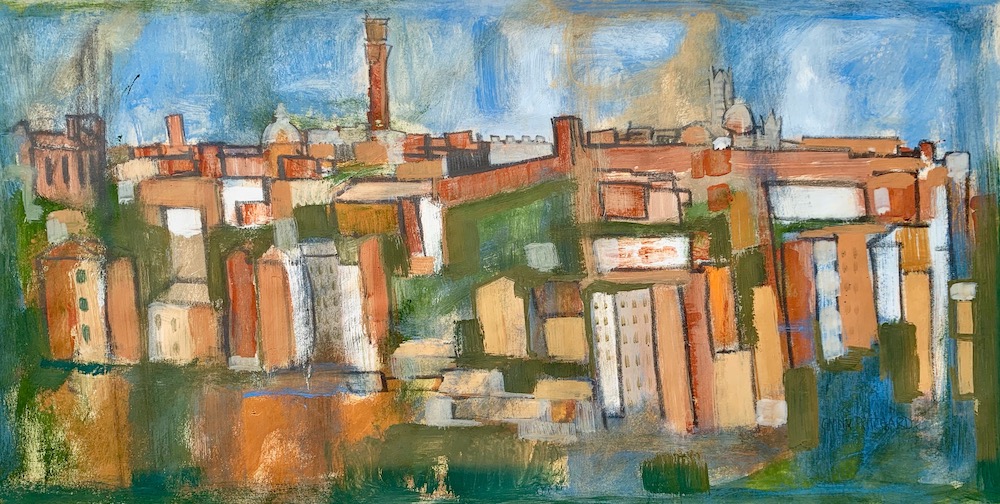
Heading northwards again, they came to Vannes in the Golfe de Morbihan on the southern coast of Brittany. Here they bought a small house on the Rue Jean-Jaurès near the harbour. Four years later they discovered the mediaeval hill town of Rochefort-en-Terre, some forty miles to the north, and – as Gwilym puts it – ‘completely lost our hearts to the place’ (BBC Wales, 1988). In 1991 they moved into a former boulangerie on the Place de L’Église, overlooking a picturesque cobbled square and the ancient Church of Notre-Dame-de-la-Tronchaye. Rochefort has a long association with the arts. The American society painter Alfred Klots purchased and renovated the château at Rochefort in 1907 and established it as a summer school for American painters.
Built on rock overlooking the Gueuzon valley, Rochefort is a small, quiet, unspoilt village, with a population of about 650. It was not unlike the landscape the couple had left behind in Wales. The stone outcrops, bracken and oak trees on the hillside, slate mines to the rear of the town, and the houses reminded them of Dolgellau. But now they enjoyed a temperate Breton climate, longer daylight hours and an improved quality of light. Prichard was truly at home in the Celtic regions of France. Of his paintings of the Brittany landscape, one critic for the Presse Ocean observed in 1993
a very Cézanne-like love of the mineral world: of stone and rock and thus of the firm, strong, vigorous and geometric structures which give power and foundation to his landscapes. Curiously, his love for this Brittany of ours appears as if it were reinforced, exalted, enriched and magnified by the love which he still retains for his harsh, severe and honest country.
In so-called retirement Prichard co-founded Rochefort School of Creative Arts. Students travelled some sixty miles to attend the painting classes offered by Gwilym and Claudia in their studio. He also returned to Wales at intervals to teach short courses at Plas Tan-y-Bwlch and to paint in his beloved Snowdonia. He lived for days on end in his Volkswagen camper as he drew and painted among the hills. The sketchbook studies he made outdoors provided aides-memoire for paintings: details of the contour of a hill or a configuration of farm buildings. Back in Rochefort he would open his Welsh sketch books for reference and begin to paint, working out his problems on the canvas. ‘Once you start painting Wales,’ he said in a BBC Wales interview in 1988, ‘then you’re physically in Wales, you can even feel the wind and the rain.’
In his paintings of Cader Idris, Tan-y-Grisiau, the Moelwyn Mountains and landscape around Ffestiniog, Prichard presented a stark and weather-beaten terrain. Geology and topography were carefully observed then distilled, the landscape pared down to its essential forms. He worked intuitively and from the heart, the paint richly and spontaneously applied to stir the emotions and imagination. Prichard captured the moods of the mountains that form the brooding landscape of Snowdonia. These paintings stir the emotions like the great seascapes of Turner or Constable’s stormy skies above his native Suffolk. The strong geometrical elements and peculiar colour schemes in landscapes compelled Prichard to interpret the world in a far more expressive and personal way. The intensity of his conviction for Wales was greater in exile; he believed he painted Wales better when not spending so much time there.
In Rochefort-en-Terre, life continued much as it had in Wales. They lived frugally of necessity, working long hours in the studio but now with the satisfaction that, in France, they believed there to be an innate sense of appreciation of art. Artists, they felt, were more valued in the community. They experienced enormous public support and interest in art. Both Prichard and Williams exhibited around Europe and were championed in the press as distinguished Welsh painters. In effect, they became ambassadors for Wales.
The move to France opened the market for their work. As well as group and solo exhibitions in Wales they exhibited in Paris and Amsterdam where galleries were always interested to look at new work. As Ian Skidmore observes in a 1998 edition of the Daily Post, the money magazine Capital even advised its readership of top French businessmen to ‘invest in paintings by Monet, Warhol, Picasso and Gwilym Prichard’. The contrast could not be more extreme between their reception in France and the way in which outsiders might expect to be confronted by insular and parochial attitudes in a north Wales village. In France it was not long before a reporter for Presse Ocean pointed out in 1993 that they had become ‘French by adoption and … more Breton than the Bretons’. Nor did the media, art establishment, or the national institutions, express any form of provincial sentiment. As a further indicator of the level of respect artists enjoy in France, irrespective of nationality, Claudia Williams and Gwilym Prichard were each awarded the Silver Medal by the Academy of Arts, Sciences and Letters in Paris in 1995.
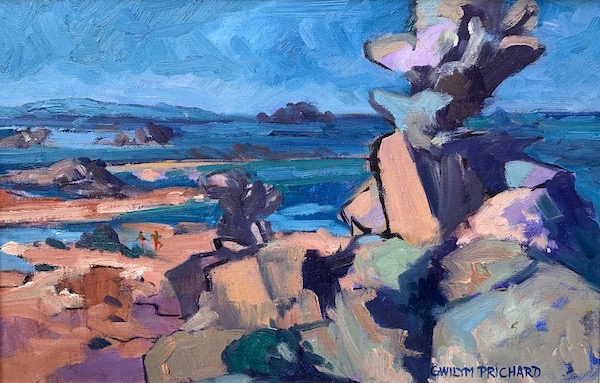
Prichard travelled throughout Brittany on painting expeditions. A critic in Ouest France observed in 1990 how he brought ‘from his native Wales a new way of looking in depth at the undeniable beauty and splendour of Breton landscapes. His palette gleams with fresh colours before moorlands of heather and broom, indented coasts and stormy skies. His colours live; his compositions breathe; the light shimmers.’ Along the coast at Belle Ile and Lesconil he painted the turbulent waters of the Atlantic that, together with furious winds, batter and shape the shoreline of the westerly regions of Finistere. On La Côte de Granit Rose, the spectacular jagged rock forms interrupt the horizon and pierce the sky. Meanwhile, inland he
set off to discover Brittany and its inspired countryside, to walk on moors and dunes scorched by the wind and the sun, to pass winding granite walls, to watch … villages and fields, coastline and sea in often unprecedented and stimulating juxtapositions of colours. Gwilym Prichard, both Breton and Welshman, knows better than anyone their originality, their strength and their unique beauty.
After nearly a decade in Rochefort, the long drive and overnight channel crossings to the UK were taking their toll. Also, Claudia was missing their grandchildren growing up in England. Gwilym would have been happy to remain in Rochefort. A compromise was reached when in 2000 they bought a house in Tenby and shared their time between Rochefort and Pembrokeshire. By spring 2001, however, they sold the house in Brittany and bought a larger house and studio in Tenby. There their art and life neatly dovetailed.
At a time of unprecedented interest in contemporary Welsh painting their work enjoy widespread popular appeal. It was increasingly represented in public collections in Britain and in private collections world wide – though Prichard to this day is not represented in the National Museum of Wales. The couple contributed to exhibitions around Wales, were featured in a documentary programmes and were represented by Martin Tinney Gallery, Wales’ premier gallery of contemporary art based in Cardiff.
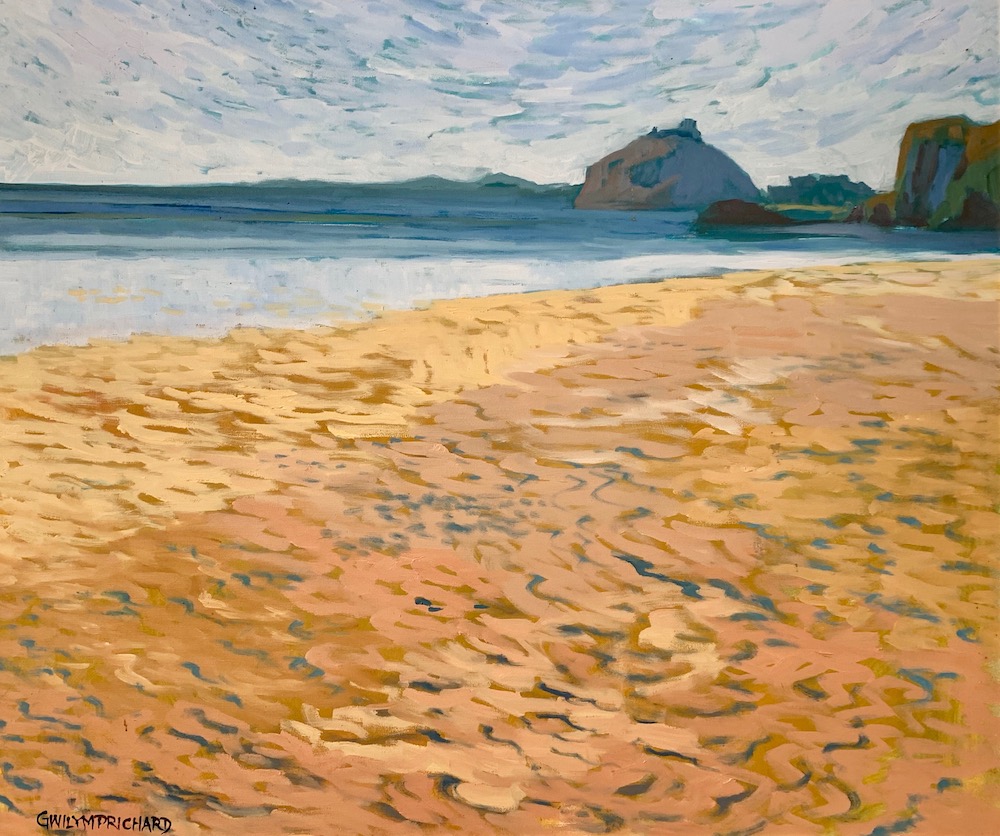
Back in Wales, not all clouds on Prichard’s horizon were storm-laden. Tenby’s blue skies and intense light peculiar to that region of Pembrokeshire inspired him to paint a colourful coastline, to present a landscape that is not always windswept and bleak. He painted Tenby bathed in sunlight on a summer’s afternoon, the coastline hazy in its warmth, the sun shimmering over the sea. Broad open skies provided a vehicle for the expansive use of palette knife and brush. The geography and climate of Tenby necessitated a softer treatment and a palette of dusty pink, rich ochre and slate blue. The locality required a more gentle handling of paint and colour than that he employed for his paintings of north Wales. Tenby offered a very different quality of light, one reminiscent of St Ives, or Pont Aven in Brittany. Without a mountainous Snowdonian background, Prichard created man-made mountains of Tenby’s Georgian townscape or focused on the coastline’s dramatic rock formations.
Many of his new paintings were based upon studies made along the Panorama Walk at Barmouth, looking down towards the Mawddach Estuary and across to the summit of Cader Idris. In his paintings he endeavoured to convey with dramatic effect his experience of the transitory and unpredictable Welsh climate. To capture its fleeting weather fronts, an approaching storm, or a break in the cloud that allows sunlight to burst on Wales’ wild and ancient places. Prichard painted an austere landscape, one divided by dry-stone walls, sheep tracks, rocks, ditches and sparsely populated with farmhouses – lonely and isolated, huddled nervously against the hillside. Like the hawthorn and bracken, each house inclined according to the direction of the prevailing winds. Solid and unchangeable, the farm buildings and stone walls are often the only indicators of human presence.

Human presence is felt but seldom represented directly, its imprint is left behind in the stone walls, telegraph poles, hedgerows, slate fences and solid white-washed farms nestling on the valley floor. Prichard captured the solitude and quietness of the land. ‘I suppose I am a lonely person,’ he wrote for his Heal’s 1974 catalogue foreword, ‘people seldom appear in my work but the effect of God and man are ever present in the life that is lived in the fields, barns and inviting farmhouses.’ The solitary farmhouses reflect the artist’s own shyness and his love of being alone in the hills. When he introduced a figure he ensured that it was in scale with the landscape. In so doing he stressed the insignificance of man in the face of nature. Kyffin Williams noted in a Heal’s exhibition foreword 1973 that Prichard:
finds it hard to keep away from his friendly cottages and farms, for Gwilym Prichard is a friendly man living in a friendly landscape. If he is friendly he is also passionate, and the rhythmic shapes underlying his picture show an emotional rather than an analytical mind.
But Prichard aimed not simply to capture the broader picture. His works were also concerned with the particular: a configuration of rocks in a lichen-covered dry-stone wall, the peculiar shape of a windswept hawthorn, a bank of grass bleached by salt air, a cluster of farm buildings, or the impressive silhouette of a mountain. Every painting has a distinctive focal point: a transitory weather front that transforms the landscape; a bend in a river across the valley bottom; an isolated farmstead; or a church – be it the magnificent cathedrals of Chartres and St David’s, the elegant spire of Llanfaes church on Anglesey, or the humble chapel at Capel-y-ffin in the Black Mountains. At Amlwch it was the stark contour of the hillside above Parys Copper Mines that appealed as well as the remains of open-pit mining that in the 1780s dominated the world market for copper ore. The windmill that appears on the horizon once pumped water from underground workings.
Prichard’s paintings are more than a response to the experience of landscape or feelings evoked by the place. They are a celebration of the media itself. Prichard learnt to appreciate and exploit the accidental. He shared with artists like John Piper the ability to manipulate the paint surface and tease out the subject that was in his mind. The vigorous palette-knife application of oil paint, the layering of watercolour, chalks, and collage combined with the distressing of rich textured surfaces are analogous to the weathering of the landscape itself. Writing for the Anglesey Bulletin of the Arts in 1961, Kyffin Williams observed that Prichard
is a happy man who loves life and is able to squeeze the utmost out of it. He makes wines from local herbs, he is a potter, and all crafts seem to come easily to him. But of course, as with most artists, painting does not. His work shows traces of struggle, physical and mental. He obviously fights the picture to try and achieve the end that is always in his mind. Sometimes a roughness results but the pictures are always true … here is somebody who knows what he wants to paint and is not afraid of showing he loves it.
After Prichard’s move to Anglesey in the mid-1950s, Kyffin Williams became a supportive friend and at one time in his early career a great influence on Prichard’s work. Prichard has, however, all too often been unfairly compared with Kyffin Williams and described as ‘Kyffin with colour’. In reality, his technique differed significantly and his range was much broader. Prichard never relied on conventions devised years before. He was fascinated by the challenges and infinite variety of surface afforded by the plasticity of oil paint. He used paint in many and varied ways. It was sometimes thick and buttery applied with a palette knife, as seen in Village in Tunisia, its slab-like impasto recalling the paintings by Nicholas de Stäel, or is used in thinned washes then scraped and scored.
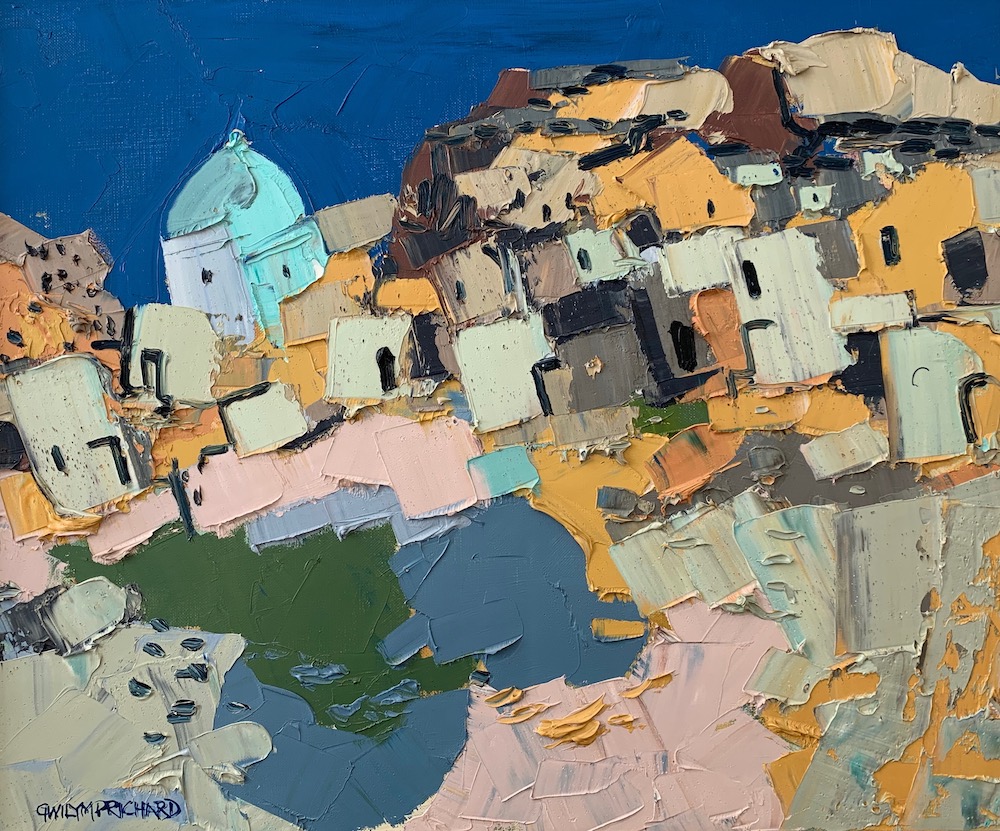
Prichard was also a confident watercolourist. This is apparent in the hundreds of works on paper he produced of Greece, Italy and the south of France in the 1980s. In addition he used collage, gesso, chalk, pastel, gouache and pencil in exciting mixed-media compositions that appear to evolve as he applied the materials. As Prichard pointed out in a 1988 BBC interview
I tend to paint in the same way as I cook; I add a bit of this and a bit of that. I think painting is very often great fun. Maybe I haven’t really matured yet, you know, I like playing with the stuff! I enjoy myself. And I think also there’s a certain amount of love that comes through … It is absolutely essential for one to paint in order to be oneself. If I were not painting, I would be miserable. We are lucky to be able to earn our living doing what we really love doing.
Prichard’s paintings are full of secrets. Close inspection reveals much more interest and colour than one might gain from a first impression. Colour is reflected in wet surfaces, a lichen-covered rock, bracken and thorn trees. Sgraffito and surface attrition are used to reveal successive layers of under painting and capture the essential characteristics of weather-beaten landscapes. Unhindered by detail, his paintings are refreshingly direct and full of bravura. He believed in working quickly to capture the emotional reaction to a landscape that initially stirred him. He used his tools and materials to feel the contours and every nuance of the inner form of the land. Ceri Richards recognised early in Prichard’s career that he possessed the ability to paint ‘the bones beneath the land.’ He quickly teased out the sensuous qualities of a landscape, the interrelationship of shape, form, colour, texture and interlocking forms.
Prichard had a capacity to go beyond likeness and capture the essence of his isolated farmhouses and lonely moorlands. His evocative landscapes possessed a feeling for place that has characterised so much British art and literature. ‘There is a deep sense of landscape that is in every Welsh man and woman,’ wrote artist Jonah Jones for Prichard’s 1988 Ceri Richards Gallery exhibition in Swansea,
and Gwilym is a dyed-in-the-wool Eifionydd man whose childhood was spent within view of the Celtic Sea and the mountains of Eryri. The lanes, fields, farms and blue hills are his subjects … for there is an unmistakable quality about them, rich paint, spontaneous brush work, fearless colour combinations, but above all that deep sense of Celtic colour and form. It is a boldness, a commitment, and a lifetime’s gazing that comes forth from his paintings of his ancient inheritance.

In 2001 the National Library of Wales staged a retrospective exhibition of paintings that I researched and curated in celebration of Prichard’s 70th birthday. Two years later he was made Honorary Fellow of Bangor University. In 2013 Sansom published the monograph I co-authored with Harry Heuser Gwilym Prichard: A Lifetime’s Gazing. Several documentaries devoted to the couple’s life in Wales and France have aired in his final years. Prichard was diagnosed with cancer and died aged 84 in his Tenby home on 7 June 2015.
Wales remained dear to Prichard. Away from his homeland he would miss ‘the sea and the ever-changing pattern of the tides; the ruggedness of the land, the limestone walls, the windswept stunted thorn trees; the quality of light that is reflected from the sea (when even on dull days gives a pear-like light) and the sound of [his] own Celtic language.’ It is Wales that now misses an artist so consummate at sharing, with such passion and integrity, his immense knowledge and experience of our landscape.
Robert Meyrick, Aberystwyth 2001 & 2019
Before its 2019 edit, this essay was published in the catalogue that accompanied Gwilym Prichard’s 2001 retrospective exhibition at the National Library of Wales in Aberystwyth, researched and curated by Robert Meyrick.
See also:
Robert Meyrick’s Gwilym Prichard obituary for The Telegraph
Harry Heuser and Robert Meyrick Gwilym Prichard: A Lifetime Gazing Sansom, Bristol 2012 * here at Amazon or here at Sansom
and Claudia Williams
* or as Wales’ national newspaper The Western Mail reviewed it, A Lifetime Grazing!
Chris Penn

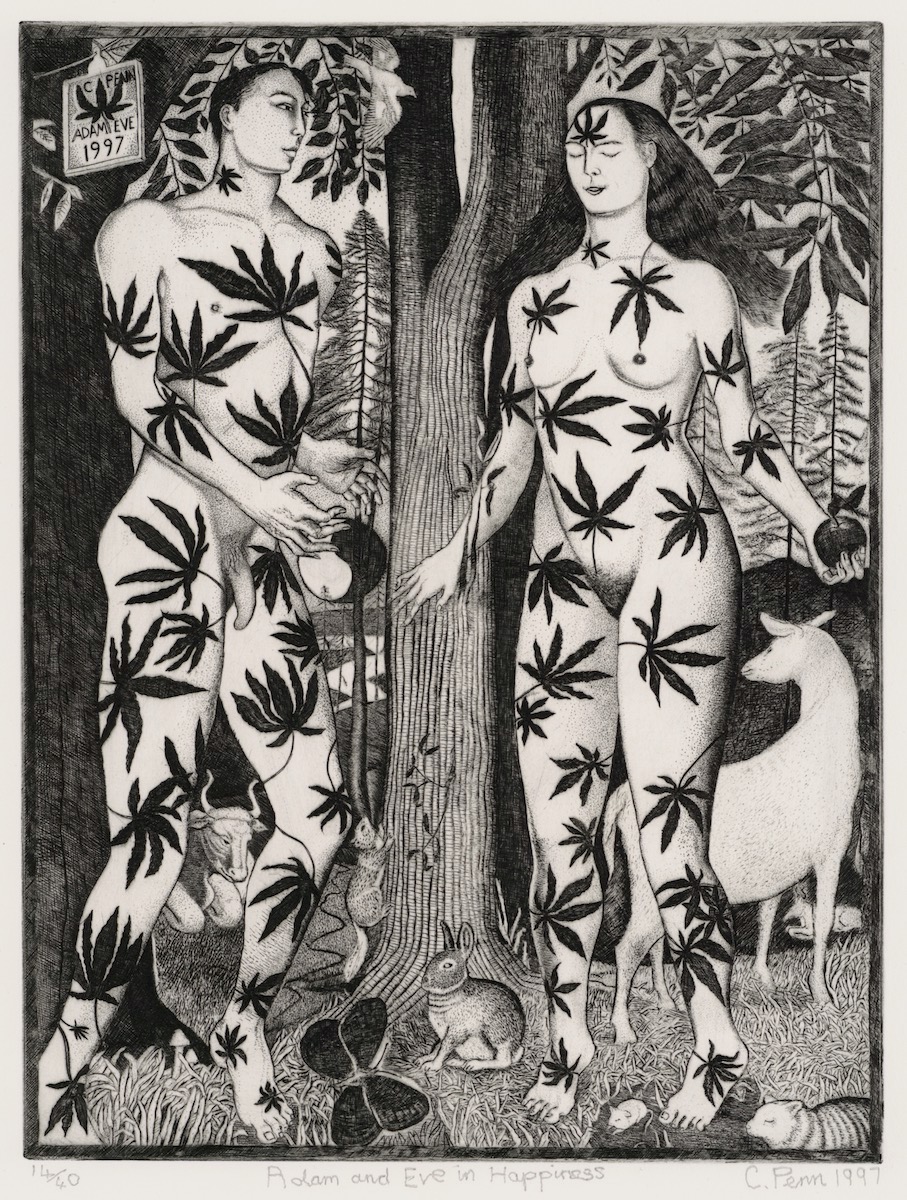
Adam and Eve in Happiness
engraving 1997
Adam and Eve in Hell: Ahead Only in Northern Ireland
engraving 1998

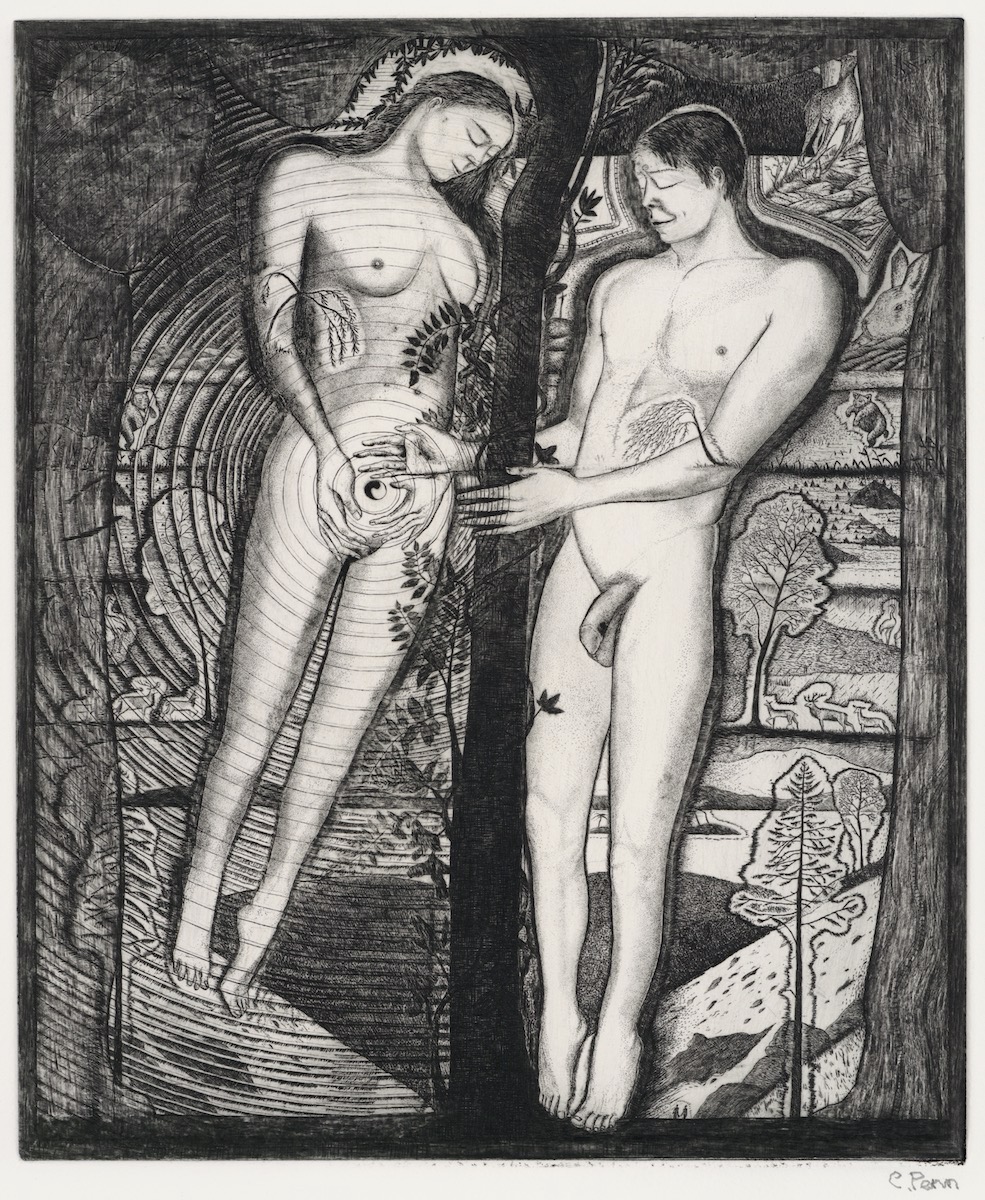
Adam and Eve
engraving 1986

Adam and Eve
engraving 1980s
Stanley Anderson

Under construction …
Handel Evans
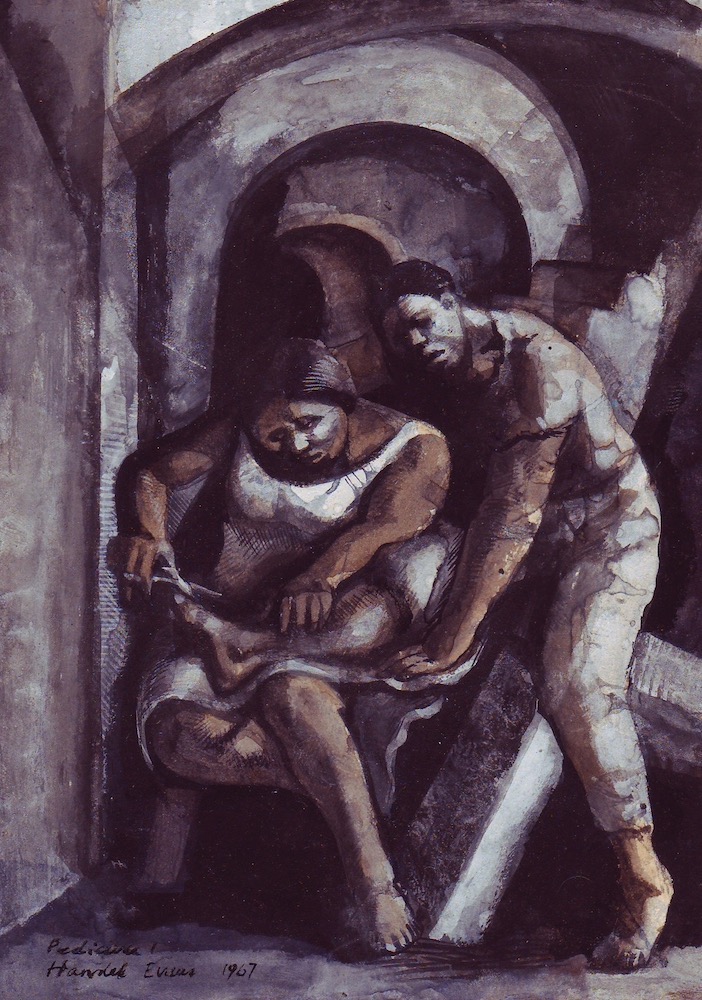
HANDEL CROMWELL EVANS
Pontypridd, Wales 1932 – Ramsgate, England 1999. Under construction …
On Collecting
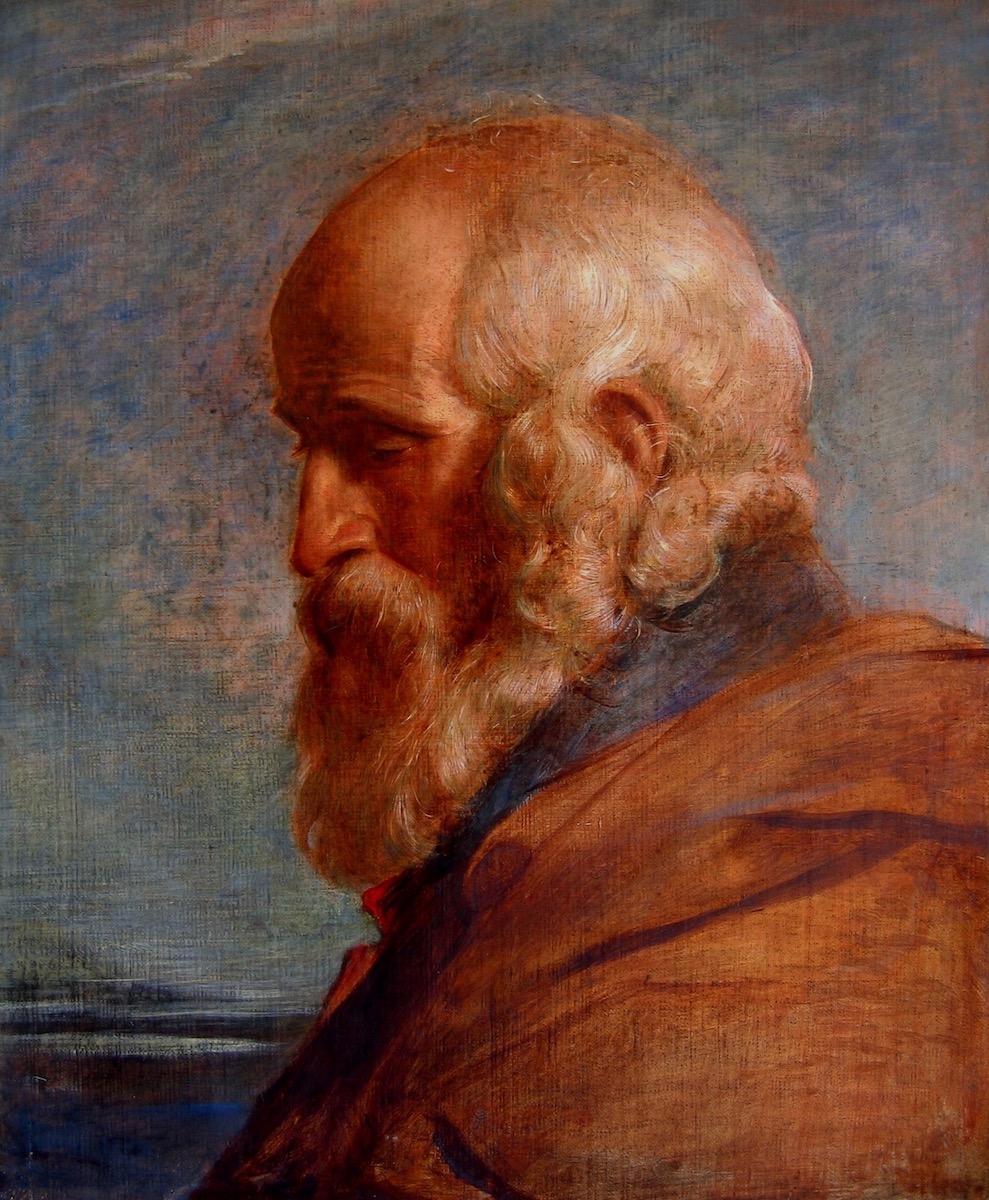
Under construction …
Harry Morley
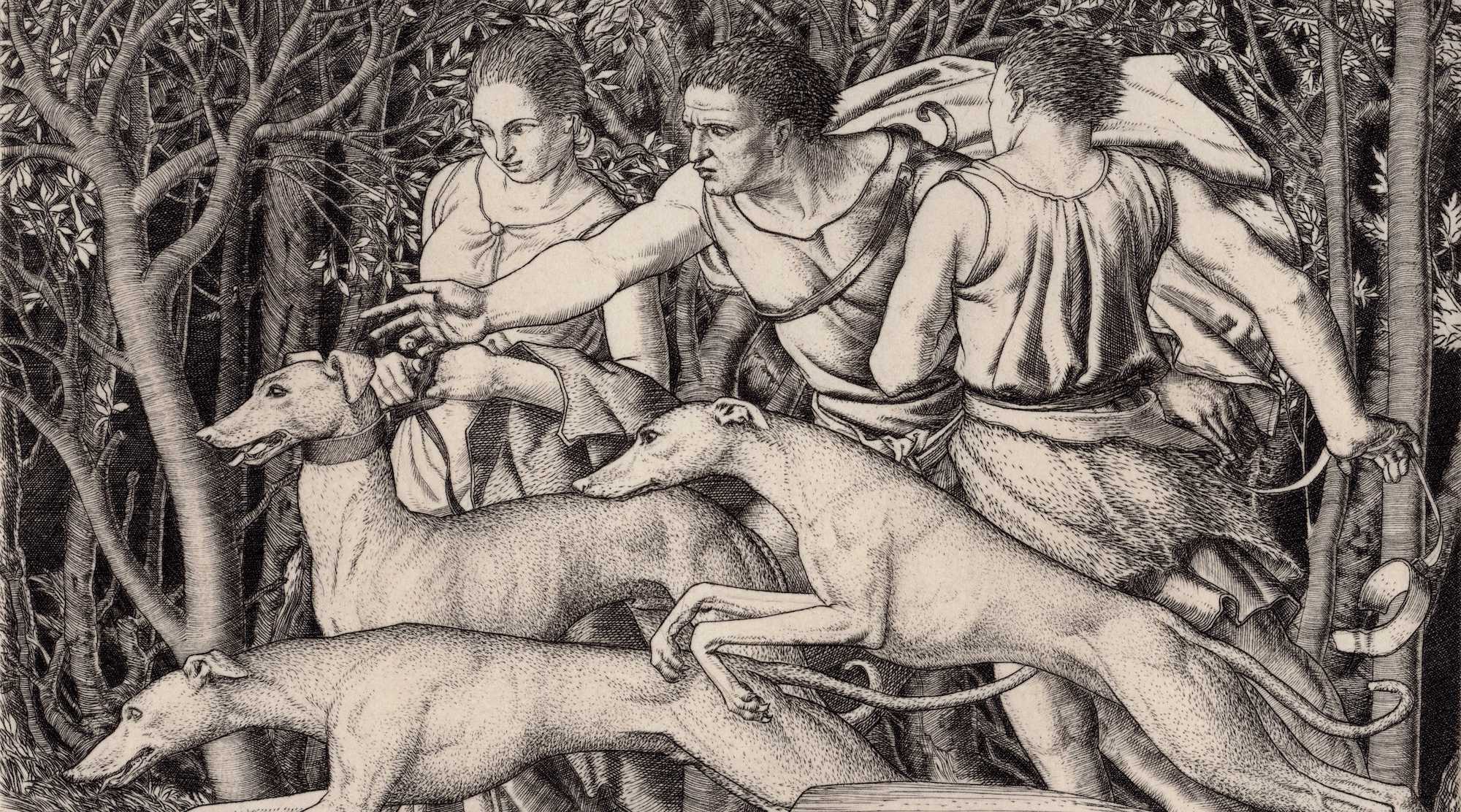
PAINTER-PRINTMAKER HARRY MORLEY ARA is best remembered nowadays for the figure paintings in oils and tempera that he exhibited at the Royal Academy of Arts from 1915. Morley’s mythological and classical figure compositions helped establish his reputation and attract critical approval: his subjects included the ill-fated satyr Marsyas who dared to challenge Apollo to a music contest (RA 1924. Tate, purchased by Chantrey Bequest); the beautiful Hylas, servant and companion of Heracles, abducted by water nymphs (RA 1923); and the Trojan mortal Paris, called upon by Zeus to proclaim the fairest among Hera, Athena and Aphrodite (RA 1926, Brighton Art Gallery). The Bible also provided Morley with rich narratives – Ruth and Boaz (1921), The Adoration of the Shepherds (RA 1921) and The Finding of Moses (RA 1928) – as did so-called romantic themes such as The Night Passeth, the Day Cometh and The Coming of Spring (both RA 1921), and Vanity (RA 1923). However, while Harry Morley devoted much of his career to the retelling in paint and print the legends of ancient Greece and Rome, his own story has never until now been told.
Following their exhibition-publication collaborations dedicated to the work of Royal Academician printmakers Sydney Lee, Stanley Anderson and Charles Tunnicliffe, Professor Robert Meyrick and Dr Harry Heuser are now engaged in a reappraisal and cataloguing of the graphic works of Harry Morley ARA RE RWS (1881-1943). Their research draws on previously-untapped family archives: an extensive collection of artworks, sketchbooks, correspondences, diaries, ledgers, photographs, and press cuttings.
MYTHOS
The Etchings and Engravings
The 1920s and 1930s marked for Harry Morley a period of success and public recognition. It was during this time that he was most active as a printmaker. Meyrick and Heuser’s catalogue raisonné of prints will comprise a critical essay together with fully-illustrated, documented and annotated entries for all 114 of Morley’s little-known etchings and drypoints (made 1919-25) as well as his 45 line engravings (made 1928-42). Until now, no catalogue of Morley prints has been attempted.
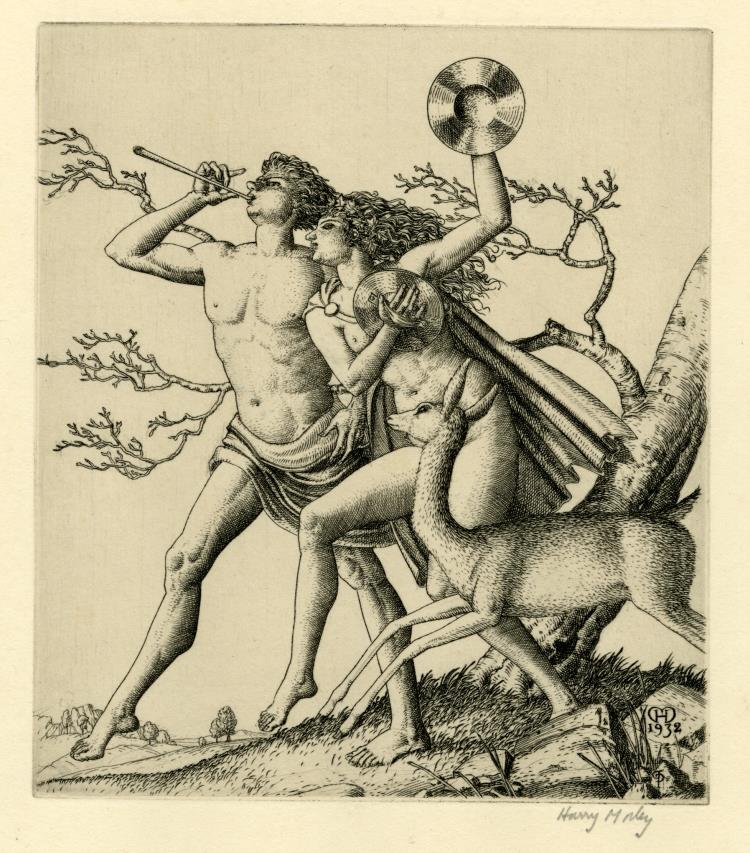
When in 1919 Morley first took up etching at the suggestion of his friend and contemporary Malcolm Osborne RA RE, he looked for subjects to the Bible (Tobias and the Angel and Samson Finding the Jawbone of an Ass, both 1920, and Christ at Emmaus 1922) and to Greco-Roman mythology (Vulcan Expelled from Olympus 1921, The Fall of Phaëton 1922, and Lapith Surprised by Centaurs 1923). Morley needled the copper plates swiftly and with assurance. Rarely did these experimental designs progress through different states. As an extension of his drawing practice, the medium was used to express his thoughts and explore compositions. Etching was for him a personal pursuit. As such, the etchings were printed in small editions and rarely exhibited.
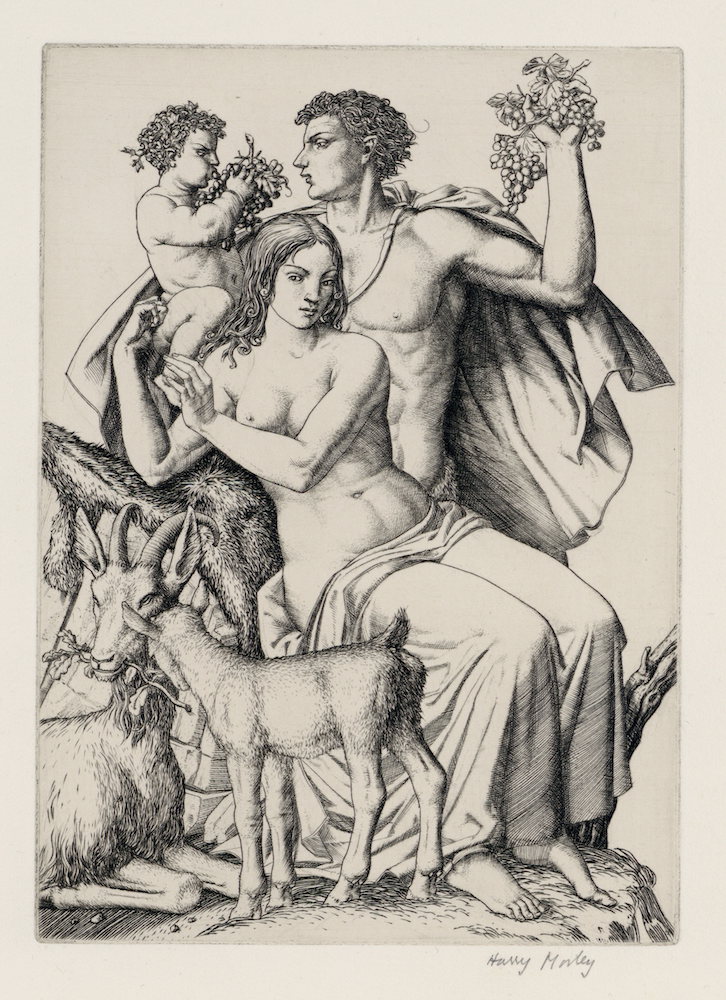
When in 1928 he was persuaded by his younger friend and Osborne’s assistant Robert Sargent Austin RA PRE to turn his hand to line engraving, Morley soon discovered that, according to John Christian, the medium’s precision better ‘suited his strong sense of form and taste for classical themes’. Published in editions of 60 by his agents P. & D. Colnaghi, the line engravings proved to be more commercially successful than the etchings. As an engraver, Morley once again took inspiration from classical myths. Venus and Cupid (1928), The Young Bacchus (1929) and The Infant Mars (1930), as well as depictions of Persephone (1929), Sylvia and Susannah (both 1930), are among his finely-wrought compositions. The engravings reflect the Arts and Crafts influence of his student days as well as his knowledge and appreciation of Italian Quattrocento art.
Together with Stephen Gooden, William Washington, Robert Austin and William Morgan, Morley is credited with re-establishing the art of line engraving in Britain. The clarity of line and restrained simplicity of engraving lent itself to Morley’s idealised figures and elegantly arranged compositions. The artist took his narratives from classical myths, and stylistically borrowed from antique statuary and fifteenth century Italian paintings, yet his engravings – centred on monolithic figures with clearly defined outlines, curvilinear forms and stylised draperies – exhibit a distinctly modern Art Deco sensibility.
In addition to mythological subjects, Morley’s engravings offer insights into Italy and a rural way of life during the late 1920s that was fast disappearing: its townscapes, festivals, pilgrimages and peasant workers. For several years Morley spent each Spring travelling and working in Italy. In 1928, he and his wife Lilias stayed with artist-friend Job Nixon sharing his studio in Anticoli Corrado. The following year, Robert Austin joined the Morleys at Anticoli. In search of interesting subjects the two men accompanied villagers on the annual two-day pilgrimage to the Sanctuary of the Madonna della Figura, Sora in the Lazio hills. In a letter dated 28 May 1929 to her daughter Beryl, Lilias described how she had watched by moonlight from her bedroom window as the pilgrimage set out into hills ‘most beautiful with clouds in the valleys all white and ghostly’. Church bells were ringing and ‘rockets and bombs’ were ‘going off at intervals’. She ‘could see in the mists the lights of the torches of other bands of pilgrims more distant’ and hear ‘their singing as they wound their way along the road’.
Without Artistic Pose
In the first of his six articles on the ‘Theory and Practice of Figure Painting in Oils’ for The Artist magazine, published between September 1936 to February 1937, Morley focussed on the challenges of ‘becoming a “modern” painter on the foundation of study of the Old Masters’. Citing Rubens, Rembrandt and Reynolds, Morley took reassurance and validation in the knowledge that many great painters before him had assimilated from the past. Writing on innovation in art, he proposed that since ‘originality is not the first among the artistic virtues […] one should never be afraid of emulating a greater than oneself’.
During visits to Italy between 1905 and 1908, Morley studied paintings by Pinturicchio, Pietro Perugino, Paolo Uccello and Sandro Botticelli. He believed himself to be the first artist of ‘recent years to base his work on the [early] Italian tradition’. Morley was not alone among artists during and following World War I who looked to another time and civilisation. As curator-historian Simon Martin points out ‘the art of Ancient Greece and Rome, as well as its mythology and literature, gave them a language and narrative through which to express their social and artistic concerns for the twentieth century’.

Whereas for Morley abstract art was a ‘dead end’ and modern art was ‘divorced from life and the accumulated experience of the ages was abandoned’, Italian Quattrocento painters showed ‘sincerity’ and ‘sound workmanship’. He believed them to be first-class craftsmen ‘without any special “artistic” pose’. The ‘stylisation of the primitives’ he attributed to a time when forms were ‘generalised and handed down from age to age’. In paint or print, Morley learned like those artists he emulated to create a sense of space without the illusion of spatial recession. In the work of the ‘primitives’ he came to appreciate the value of front lighting ‘to emphasise linear forms’ in decorative work without the ‘complication of cast shadows’. Render fine form in space, he advised readers of The Artist, enhance it with good colour, and ‘we cannot be far wrong’.
As John Christian points out, the artist’s ‘strong sense of monumental form and spatial clarity’ may also reflect his early training as an architect. With its academic coolness and detachment, Morley’s work is distinguished from the narrative purpose and sentiment of the Pre-Raphaelites. Art historian William Gaunt attributed that detachment to the ‘aloofness of idealism’. As Gaunt points out in his March 1925 article for The Studio, Morley took the ‘imperfect tradition’ for his model and made it ‘his business to evolve something original out of the incomplete’. Morley alighted on the Renaissance, resting on ‘an art obviously capable of the highest development – that of the Early Florentines’.
Mindful that for his contemporaries the painting of nudes was ‘limited to the bedroom, the bathroom and the bathing-beach’, Morley turned to ‘unfashionable’ classical subjects. Sir William Smith’s ‘ever-useful’ A Smaller Classical Dictionary (London: Dent, 1910) provided him ‘enough description from which to work’ and elaborate upon. A good story notwithstanding, he cautioned readers that a painter is not a ‘historian or an archaeologist, and that his primary purpose is not to tell a story. His main business is with the pictorial aspect of the subject in hand’.
Unpretentious compositions, strong of form and firm of outline, called for an appropriate technique. As well as aesthetic and narrative influences, Morley was also inspired by techniques of the past. Egg tempera – or oils on top of tempera painting – became his preferred medium. Though he did not slavishly follow their recipes or technical specifications, Morley learned much from Christina Jane Powell Herringham’s translation of The Book of the Art of Cennino Cennini: A Contemporary Practical Treatise on Quattrocento Painting (London: George Allen and Unwin 1899) and his friend Maxwell Armfield’s A Manual of Tempera Painting (London: George Allen and Unwin 1930). Morley admired the technical achievements of the past, followed new research on the science of traditional painting techniques, and insisted that ‘craftsmanship does count and always will’.
In her 2005 essay for Joseph Southall 1861-1944 published by the Antique Collectors Club, Abbie Sprague claims that the revival of British interest in tempera painting had begun in 1901 with the formation of the Society of Painters in Tempera. The Society held some of its meetings in Morley’s studio. John D. Batten, the painter-activist Mary Sargant Florence, Francis Ernest Jackson, Maxwell Armfield and Joseph Southall were among the regular attendees. As the medium became better understood, the 1920s saw a ‘Tempera Revival’ in British art. However, it was only after the Royal Academy of Arts’ ground-breaking Italian Art at the Exhibition at Burlington House (1 January – 20 March 1930) that the Academy accepted contemporary tempera paintings in its Summer Exhibition. Morley’s tempera The Young Bacchus was one of thirty-six tempera paintings shown that first year.

Harry Morley: A Biographical Sketch
Leicester, 5 April 1881 – London, 18 September 1943
In 1897 Harry Morley enrolled to study architecture at Leicester School of Art. Three years later he was awarded a scholarship to continue his training under Professor Beresford Pite at the Royal College of Art (RCA) in 1901. He won an RCA scholarship in 1903 which enabled him to visit Italy for the first time. Later that year, with £150 from his father Thomas Morley, a Leicester hosiery manufacturer, he was articled to Beresford Pite whose architectural practice was on the RCA campus. Morley also attended the mural painting department and evening life classes. In 1905 he was awarded an RCA Travelling Scholarship in Architecture as well as the RIBA Owen Jones Studentship and Travelling Scholarship for the Study of Colour Decoration. These awards allowed him to spend long periods in Italy between 1905 and 1908. There he came to admire early Renaissance painters.
Now resolved to become a painter himself, Morley gave up architecture and attended open studios in Paris during 1908: at the Académie Julian, Académie Colarossi and Académie de la Grande Chaumière. He returned to London and began a career as professional artist. On 6 September 1911, Morley married Lilias Swain (Hyde, Cheshire 3 January 1880 – London 30 January 1973) at St Philip’s Church, Earl’s Court Road, Kensington. The couple honeymooned in Florence, Venice and Paris.
Lilias was teaching calligraphy and embroidery at the Royal College when she and Morley became engaged. She had studied design there under William Lethaby. She was trained in lettering and illumination by Professor Edward Johnston and went on to become his first assistant. She studied embroidery under Grace Christie (1872-1953) whom she assisted after her graduation. Lilias shared digs in Chelsea with fellow RCA student Sylvia Pankhurst who, like Lilias, was from Manchester.
A weak heart and lifelong asthma excluded Morley from active service during both wars. The Morleys lived in Earl’s Court and from 1918 in Kensington. In 1923, Thomas Morley purchased for his son, wife and their two daughters a four-storey terraced house on Pembroke Road. Here he established home and studio. The couple had two daughters, Elinor Beryl (7 September 1912 – 26 September 1998) and Julia Morley (2 September 1917 – 16 May 2008), both of whom went on to train at the Royal Academy Schools. Julia Morley won a scholarship to study mural painting at the Slade School of Art and became a professional painter and muralist.
The Morley family holidayed in Italy in the Spring and during August each year in addition to sketching holidays to countryside or coastal regions of England and Wales. They were often joining – or joined by – artist friends. John Christian points out that his watercolours, which looked back to Philip Wilson Steer and the English landscape tradition with a ‘strong sense of place, technical assurance and characteristic integrity’, were noted for their ‘freedom and spontaneity’. As Lilias Morley recalled, ‘when working in watercolour he worked very rapidly and with great concentration, completely oblivious to anything going on around him. If a first attempt did not please him he tore it up and immediately painted another one of the same subject’.
Despite the worldwide economic recession following the Wall Street Crash of 1929, Morley continued to paint and engrave throughout the 1930s. From September 1932, he taught painting and life drawing two days a week at St. Martin’s School of Art and took on portrait commissions to supplement his income. Morley’s friend and Keeper of the Royal Academy Schools, Sir Walter Westley Russell RA employed him as visiting teacher.
Late in 1940 Morley’s home and studio were bomb damaged and left uninhabitable. He and Lilias relocated to live with his newly married daughter Beryl and her husband Captain John Castle. They shared a small cottage in Wool, Dorset near the Army Fighting Vehicle School at Bovington Camp where Castle trained soldiers to drive tanks.
The Ministry of Information provided Morley with a permit to make drawings of the Camp. Other commissions followed including one to record the destruction at Southampton docks. Morley also completed a number of short commissions for the War Artists’ Advisory Committee and recorded undergoing repairs to damaged vessels at Falmouth. These paintings are now in the Imperial War Museum. At Wool, Morley had his first heart attack. The couple returned to Kensington in 1943. Weakened by a series of heart attacks and bouts of asthma, he died in September that year.
Lilias remained at 4 Pembroke Road until her death in January 1973. Morley’s studio remained largely undisturbed during this time. When Lydia Russell died in 1944, Sir Walter Westley Russel, Keeper of the Royal Academy Schools (1927-42), lodged with Lilias Morley in rooms at the top of the house. He died there in April 1949. Carel Weight RA, Professor of Painting at the Royal College of Art, rented Morley’s studio to the rear of the property accessed from Pembroke Walk.
Professional Affiliations
The ethos and camaraderie of artist groups appealed to Harry Morley. He was an active member of the following societies and institutions:
1921
Member of the Society of Graphic Art
1921
Member of the Art Workers’ Guild
1923
Member of the Society of Mural Decorators and Painters in Tempera
1924
Member of the Royal Society of British Artists (RBA)
1927
Associate Member of the Royal Watercolour Society (ARWS)
1929
Associate Member of the Royal Society of Painter-Etchers and Engravers (ARE)
1931
Faculty of Engraving at the British School at Rome
Fellow of the Royal Watercolour Society (RWS)
Fellow of the Royal Society of Painter-Etchers and Engravers (RE)
1936
Master of the Art Workers’ Guild
Associate of the Royal Academy of Arts (ARA)
Member of the Royal Society of Portrait Painters (RP)
1937-1941
Vice-President of the Royal Watercolour Society (VPRWS)
Illustrated Books
Edmund B. d’Auvergne
The Nightside of Paris (Werner Laurie, 1909)
Richard Penlake
A Book of Modern Palestine (London: Thomas Nelson, 1910-13?)
Edward Verrall Lucas
A Wanderer in Florence (London: Methuen, 1912)
Alfred H. Hyatt
The Charm of Paris (London: Chatto and Windus, 1913)
Alfred H. Hyatt
The Charm of Edinburgh (London: Chatto and Windus, 1913)
Charles Tennyson
Cambridge from Within (London: Chatto and Windus, 1913)
Edward Verrall Lucas
A Wanderer in Venice (London: Methuen, 1914)
Edward Hutton
Cities of Sicily (London: Methuen, 1926)
Edward Verrall Lucas
A Wanderer in Rome (London: Methuen, 1926)
 Robert Meyrick